Support CleanTechnica’s work through a Substack subscription, on Patreon, or on Stripe. Help us produce all the original, high-quality content we publish week after week despite the challenges of AI deleting content, anti-social media, inflation and other obstacles.
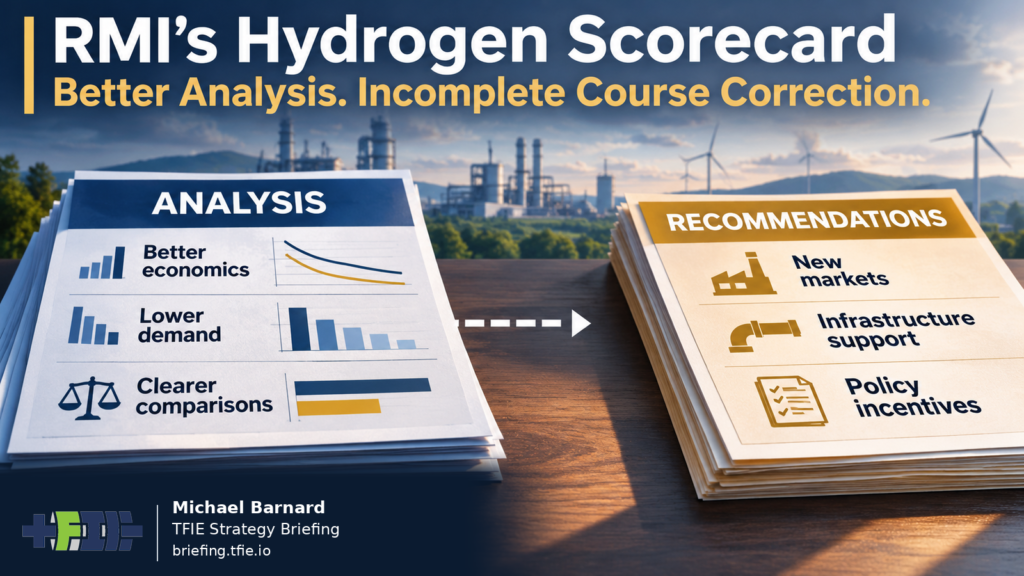
RMI has become much more realistic about hydrogen demand and competing technologies. That makes the gaps between its findings and its recommendations harder to excuse. Its latest work recognizes that battery-powered trucks generally do better economically than hydrogen fuel cell trucks, that Europe needs much less hydrogen in 2030 than originally targeted, and that low-emission ammonia still costs substantially more than conventional ammonia. Several recommendations still seek public money to develop the same hydrogen markets that research has found difficult to justify.
I have been challenging this tension since January 2024. RMI is important because governments, investors and industrial companies use its research to decide where to spend money. Its hydrogen program has made real analytical corrections. You have not made all the strategic decisions that come with it.
Consider RMI’s February 2026 report on hydrogen transportation in India. Benchmark comparisons find that fuel cell trucks do not reach cost of ownership parity with battery electric trucks until 2040, including the long-haul use case. The report also explores a much more favorable hydrogen price in an alternative sensitivity, bringing fuel cell trucks closer to parity. These are different findings, and the starting point is important for current investment decisions.
However, the report recommends subsidies for hydrogen vehicles, support for filling stations, production incentives and tax relief. He sees a parallel market for hydrogen trucks as something that needs to be built. The arguments in favor of spending public money on that market should start with evidence that a particular charging service cannot be served as well or better with batteries. The reported cost advantage of batteries doesn’t disappear when the policy section begins.
The problem goes beyond India. RMI’s 2025 U.S. Hydrogen Report states that battery-powered trucks are more market-ready and have a lower total cost of ownership, especially in the near term, but calls for hydrogen refueling and distribution infrastructure along freight corridors. The independent NACFE Run on Less Owner-Cost work, developed within RMI’s freight transportation research ecosystem, projects that batteries will become the lowest-cost option across their modeled duty cycles by 2035 without incentives. Hydrogen remains the most expensive option in almost all of them. These findings support battery infrastructure as the default option and a high level of evidence for hydrogen exceptions.
RMI already knows how to make appropriate distinctions in other areas. Its 2026 steel study separates hydrogen used to reduce iron ore from hydrogen burned simply to provide process heat. In the illustrative plant, electric heat requires around 850 GWh per year, compared to 1,300 GWh of electricity to produce enough additional hydrogen for heating. That’s the kind of direct comparison of services that should govern recommendations across the organization.
Its new Green Ammonia Buyers Alliance also has a coherent industrial purpose. Fertilizer production already requires ammonia, commonly made from fossil-based hydrogen. Purchasing lower-emission ammonia to replace that supply addresses an existing industrial input. There is no need to invent a new energy market for ammonia combustion.
Europe shows how better diagnosis can coexist with excessive political ambition. RMI’s recalibration in March 2025 reduced the mandate’s expected demand for renewable hydrogen driven in 2030 to 2.2-2.8 million tonnes, well below the EU’s original supply and import ambition of 20 million tonnes. Their analysis identifies €13.9 billion in public support under existing mandates, plus €31.7 billion for an accelerated scenario. The combined €45.6 billion deserves a comparison with other ways the industry could source the same low-carbon products and services, including direct electrification and imported green materials.
That comparison changes the question of ammonia, steel and refining. A European fertilizer or chemical manufacturer needs ammonia, not necessarily hydrogen manufactured within Europe. A steel manufacturer needs iron that meets its quality and emissions requirements. A mill needs process heat at specific temperatures. Governments can pay a premium to preserve internal security or resilience capacity, but the benefit must be valued and the public cost made explicit.
My November 2026 European Hydrogen Assessment applies that approach. In its central scenario for 2050, ammonia produced in Europe with green hydrogen on site costs approximately 1,222 euros per ton. Qualifying imported green ammonia costs between 745 and 755 euros per ton depending on the model assumptions. These are modeled values, not vendor offers. They demonstrate why an analysis that starts with hydrogen production targets can lead to the wrong infrastructure plan.
RMI’s China Green Ammonia and Methanol Report 2026 acknowledges that green production costs remain two to three times higher than conventional costs and that demand development lags behind supply ambitions. However, the report discusses the expansion of ammonia and methanol as energy carriers, including ammonia for electricity. The relevant comparison for electricity is renewable generation with storage and other flexibilities, not just fossil-based ammonia. RMI has not shown that adding an ammonia combustion path wins that comparison.
This is as much a strategy problem as a modeling one. Using Richard Rumelt’s framework, RMI’s diagnosis has improved, its guiding policy remains too committed to the expansion of hydrogen markets and some coherent actions are missing. An economically unfavorable comparison should be able to terminate an infrastructure recommendation. Instead, it too often generates proposals for subsidies that would facilitate the sale of the hydrogen route.
RMI has the experience to correct this. Their recommendations on hydrogen should include explicit comparisons of alternative technologies, investment thresholds and exit criteria. The review of all programs should include researchers measuring the costs of batteries, industrial electrification, transportation operations and grid flexibility. Where hydrogen is an essential chemical input or is demonstrably the best means of delivering a service, support it. When competing technologies win in implementation costs and availability, we must stop trying to create demand through policies.
The full TFIE Strategy Briefing evaluation examines RMI reports from the US, India, Europe and China side by side, including the differences between their findings and recommendations. It also links the original sources and the 2024 critique.
For the underlying comparisons, read TFIE’s open assessment of Europe’s hydrogen strategy, with its research report, evidence book and interactive dashboard. Subscribe to TFIE’s strategic report for more independent analysis on where decarbonisation spending can deliver the biggest results.
Sign up for CleanTechnica’s Weekly Substack to get in-depth analysis and high-level recaps from Zach and Scott, subscribe to our daily newsletter, and follow us on Google News.
Do you have any tips for CleanTechnica? Do you want to advertise? Want to suggest a guest for our CleanTech Talk podcast? Contact us here.
Subscribe to our daily newsletter to receive 10-15 new cleantech stories per day. Or sign up to receive our weekly newsletter on the week’s top stories if the daily grind is too much.
CleanTechnica uses affiliate links. See our policy here.
CleanTechnica Comment Policy