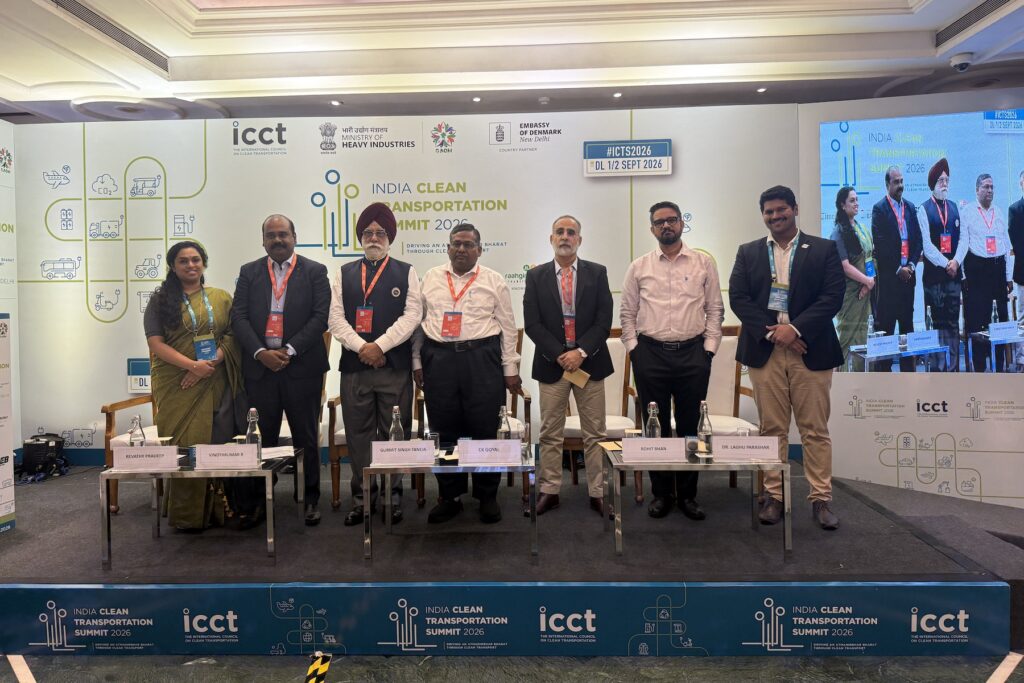
Between 30 and 35 percent of the 1.6 million privately operated buses in India are used for school transportation and fall under the category of educational institutions, said Dr. Laghu Parashar, senior transportation specialist at the World Bank, during a panel discussion on electrification of India’s school bus fleet at the Clean Transportation India Summit 2026. He highlighted the potential for school transportation to be the first segment of the private bus market in see electrification at scale. “If the opportunity arises, I think school transportation will be the first mover in the private sector,” Parashar said.
While the private bus market also includes intercity transport, personal transport and tourist transport, Parashar identified two main reasons why school transport could be the first to move forward on the electrification front. One of the main challenges in adopting electric buses for private transport companies is the availability of land.
Most private bus operators have small fleets and do not own dedicated parking spaces, generally parking their buses on the side of the road, under flyovers or in rented spaces. Therefore, private operators lack suitable places to install charging infrastructure. Schools fare better in this regard because they typically have land available on their premises.
The second reason is the need for significantly less autonomy. While buses used for inter-city, tourist and personnel transport applications mostly cover triple-digit distances each day, Dr Parashar pointed out that school buses typically cover only 50-60 kilometers daily. School buses also sit idle for several hours between their operating hours during the day, providing enough time to charge even via an AC charger.
Vinoth Kumar R, head of planning and strategy at Switch Mobility, highlighted another reason why school buses could lead electrification in the private sector. Their gross vehicle weight (GVW) can be 1 to 1.1 tons lighter than that of normal city buses, because their passengers are mainly children. He added that 70 per cent of the school buses currently in operation in India have a capacity of 30 to 40 people and also that most of the school buses are run without air conditioning. With lower weight, range, seating and feature requirements, electric school buses can be much simpler and more cost-effective than models designed for other applications.
On the other hand, unlocking this potential will require greater investment from OEMs in the development of purpose-built electric school buses. Kumar said OEMs need to work on customized solutions for school bus electrification, adding that 30- and 40-seat models would be the “sweet spot” for this application.
Kumar highlighted that OEMs and suppliers must work together to make electric school buses more affordable, as they currently cost almost twice as much as comparable ICE models and schools will not be able to afford the premium. “We need to treat this as something mainstream, a set of products available to customers, to operators. And then, you know, we need to go all the way. And only then things will reach electrification on a much larger scale,” said Vinoth Kumar R, Head of Planning and Strategy at Switch Mobility.
Haryana-based electric bus manufacturer PMI Electro Mobility Solutions, which has so far deployed over 3,300 units in over 34 cities, has conducted pilot tests for school transport. But these tests showed that schools are unwilling to absorb any additional costs associated with the transition. “None of the schools are willing to spend even a single penny on switching from ICE bus to electric bus,” said CK Goyal, chief operating officer, SPV operations, PMI Electro Mobility Solutions.
In addition to land availability and high costs, the significant investment required to establish dedicated charging infrastructure is another concern for private bus operators, particularly those serving schools. An investment of this type may be financially viable only for schools that operate a large fleet. “For a school that has 5 buses, 10 buses, having independent charging infrastructure is definitely not going to work. And it will only increase the cost,” said Rohit Bhan, head of strategy at Chartered Speed.
OEMs and industry specialists have welcomed Delhi’s EV policy in this regard. The national capital has made it mandatory for all schools to convert at least 30 per cent of their bus fleet, whether owned, leased or contracted, to electric models by March 31, 2030. To support this transition, Delhi proposes to allow school buses to use charging facilities at public bus stations.
At the national level, the Ministry of Heavy Industries (MHI) is evaluating a new plan that could potentially support 50,000 electric buses (and also 50,000 electric trucks). MHI is considering benefits such as subsidized loan interest rates, a partial credit guarantee mechanism and an interest subsidy for charging infrastructure under the proposed plan, which will reportedly involve an outlay of Rs 98.52 billion (approximately €897 million).
Dr Parashar suggests that the central government should follow Delhi’s example and introduce a national mandate for electric school buses to speed up the transition. According to a World Bank assessment currently under review, there could be around 90,000 private electric buses plying on Indian roads by 2030, with educational institutes, including schools, accounting for about 35 per cent of the volume. By 2035, the country’s private electric bus volume could roughly double to between 180,000 and 190,000 units.
Source: electrive at ICTS 2026