Krakatau, a volcanic island in Indonesia, killed more than 30,000 people when it erupted in 1883. One might assume that volcanic debris posed the greatest threat, but many of the victims died from a tsunami caused by the volcanic eruption.
Volcanoes in the sea can pose very different dangers to those on land, as their impact can vary depending on how volcanic activity interacts with seawater. In the deep ocean, high water pressure can suppress explosive volcanic activity, making eruptions less destructive. But closer to the surface, the lower water pressure and high temperatures of the volcanic material can cause violent explosions. However, scientists still do not fully understand the conditions under which volcanic activity can cause a tsunami.
To better understand these risks, an international team of researchers examined the 2022 Hunga eruption in Tonga, focusing on the rapid collapse of the caldera that may have amplified its powerful tsunami. Calderas form when the ground above a magma reservoir collapses as the magma drains. Comparisons of seafloor topography before and after the eruption showed that a caldera approximately 4 kilometers wide sank by approximately one kilometer during the eruption.
Researchers maintain that the rapid collapse of the entire caldera may have intensified the massive tsunami. Even a relatively small caldera like Hunga may be capable of producing a dangerous tsunami, depending on the speed and nature of its collapse. This suggests that other underwater volcanoes may also have the potential to generate dangerous tsunamis. Still, the document warns: “The dynamics of eruptions that form underwater calderas, and therefore the dangers they pose, are not well understood, due to the relative inaccessibility of the resulting calderas and eruption products.”
A roof too thin to support
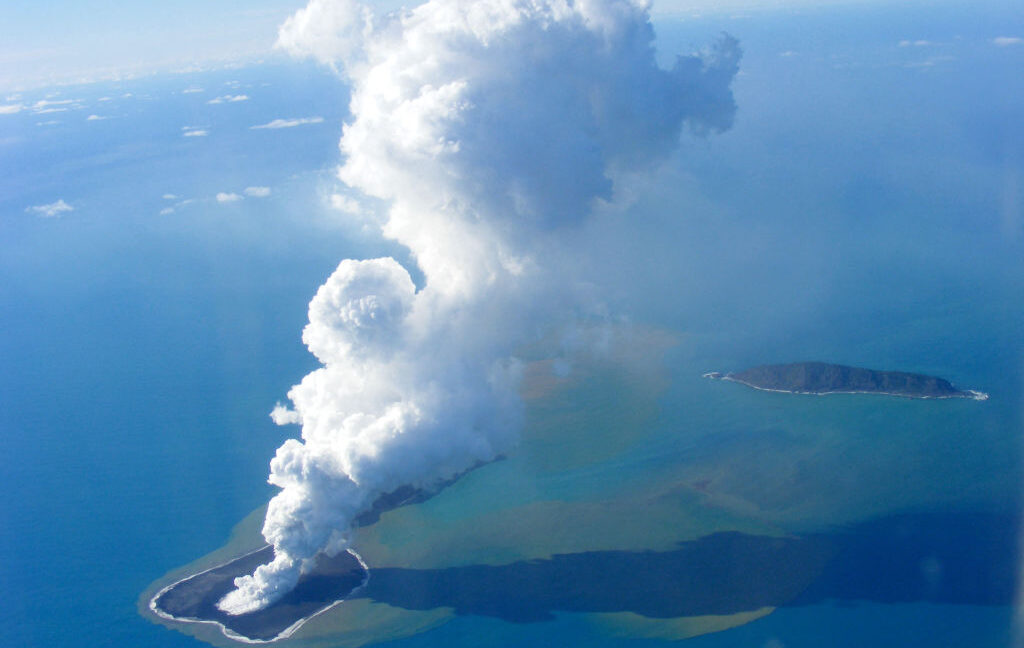
The eruption of the Hunga volcano on January 15, 2022 is among the most powerful volcanic events of this century. The eruption plume rose more than 55 km, pushing vaporized seawater into the stratosphere, and the pressure wave from the explosion was detected around the world. It is estimated that the tsunami that accompanied it reached heights of 40 meters about 100 kilometers from its origin. It is the highest tsunami ever recorded from an underwater volcanic eruption.