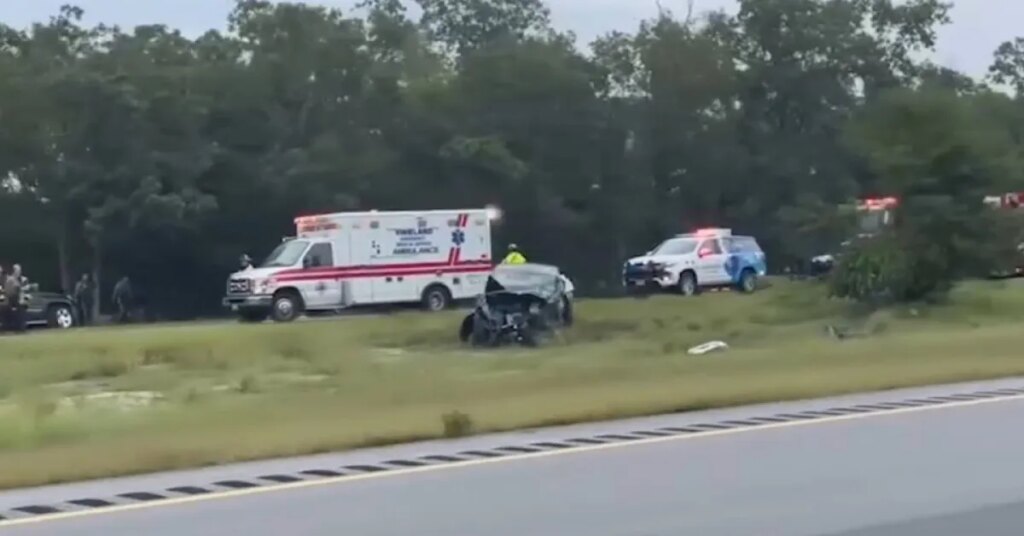
A Tesla crossed the grass median of Route 55 in New Jersey, struck a tree, slid into oncoming traffic and crashed head-on into an SUV. The driver of the vehicle, Phillip Eastman, 68, died.
Police reported him as a driver who lost control. What they didn’t say, and probably didn’t know, is that Tesla’s own report to federal regulators says the car’s driver-assist system was activated. This is part of an ongoing investigation by Electrek that compares reported accidents with data redacted by Tesla’s NHTSA.
What happened on Route 55?
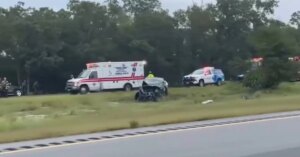
Around 8:31 a.m. on Saturday, August 22, 2026, a Tesla was heading south on Route 55 in Vineland, Cumberland County, near mile marker 34.6. The driver lost control, went off the left side of the road, crossed the grass median, struck a tree and continued into the northbound lanes, where the car collided with a northbound Chevrolet pickup truck, according to New Jersey State Police.
The driver of the SUV, Phillip “Phil” Eastman, 68, of Springfield, Pennsylvaniawas murdered. The driver of the Tesla and a passenger in the Chevrolet were injured and taken to a hospital with moderate injuries.
Eastman had just been sworn in as a Springfield School District board member and spent nearly three decades coaching youth and high school ice hockey, including 17 years as varsity head coach at Springfield High. His death was widely covered in the Philadelphia area.
And in all of this, no report mentions Autopilot, “full autonomous driving” or any driver assistance system. The accident occurred when a driver lost control of his vehicle.
What Tesla told the federal government
Under a standing NHTSA general order, automakers must report crashes in which a Level 2 driver-assist system was activated within 30 seconds of impact and someone was killed. Tesla filed a report on this accident.
In it, Tesla identifies the car as a 2021 Model Y and mark the automation “Engagement Status” as “Verified Engaged” – meaning that Tesla confirmed through its own telematics that Autopilot or “full self-driving” was active. It lists the New Jersey State Police as the investigating agency and says it learned about the accident through the media.
Then you write up the fields that would explain what the car did: the accident narrative, the software version, and whether the road was within the system’s approved operating area. Everything labeled as “confidential business information”, the same wordings that Tesla applies to 99.9% of its reports.
What the data does not agree
We want to be precise about what this proves and what it doesn’t. “Activated within 30 seconds of impact” is the trigger for the report, not proof that the system was spinning when the car crossed the median. The driver may have been ignoring you. And Tesla wrote the software version, so it’s not known if this was a basic autopilot or an FSD.
Two more gaps are worth noting. Tesla records a pre-crash speed of just 37 mph, low for a highway, which is more likely to be a single telematics snapshot from the pre-crash window than the speed at which the car left the road. And in this report, Tesla only verifies that it contains the car’s telematics, not the event data recorder or the video, so there may be less evidence on board here than in other cases.
What is not in doubt is a fact the public never knew: A driver assistance system was activated in a car that crossed a freeway median and killed a man. Everything that would explain how it is sealed.
Why do we keep doing this?
This is the pattern that keeps showing up in research, and it’s why wording is important. Tesla, more than ever, is pushing owners to treat a Level 2 driver assistance system as if it were driving itself. Selling the software as “fully autonomous driving,” Elon Musk continues to promise that unattended autonomy is near and the brand invites drivers to trust the car.
But it’s still Level 2. The human drives and is responsible at all times, and Tesla’s own actions bear this out: consumer FSD still requires oversight, and its robotaxi service is a small, closely watched fleet. Right now, Tesla tells owners to trust the car, hides records that would show how the system behaves when things go wrong, and a man who coaches kids’ hockey one season is a name in a sealed federal file the next.
How we combine it and why it is notable: Electrek flagged this crash weeks ago, off the news, as a fatal Tesla crash that had no corresponding entry in federal data and no public mention of driver assistance. The latest statement from NHTSA added it, marking it as a fatality with the verified system activated. The record is unredacted as to location (Vineland), state, vehicle (2021 Model Y), death and month, and the time of the incident Tesla recorded, 12:29 UTC, converts to approximately 8:29 am local, within two minutes of the police report at 8:31 am. It’s the same accident. Electrek contacted the New Jersey State Police for the crash report and vehicle data, and asked whether investigators received raw telemetry from Tesla or just Tesla’s own interpretation.
Electrek’s opinion
If you remove the wording, this is a Tesla, running its driver assistance software, crossing a median and killing a school board member in the oncoming lane. Leave it in place, like Tesla did, and you are a driver who “lost control.” Those are very different stories, and the public understood the one that leaves Tesla out of this.
We are careful here. The fact that the system is activated does not prove that it caused the accident, the driver may have overridden it and we don’t even know if it was autopilot or FSD. That’s exactly the problem. Tesla knows everything. You have the telematics, you filed the report confirming that the system was activated, and you decided that what your car did in a fatal accident is a trade secret, until you know what software was running. Phillip Eastman’s family and the police still investigating deserve the full story, not a redacted one.
Tesla is already under investigation by NHTSA over how it reports these accidents. We will continue to match them, one by one, until the record is complete.
If you drive a Tesla, powering it with home solar is one of the cheapest ways to reduce fuel costs to almost nothing. With electricity rates increasing nearly 10% last year and expected to continue rising, solar energy is one of the best ways to protect yourself against rising costs. And with leasing and PPA options, you can do it with no upfront cost and start saving right away. If you want to find the best deal, check out EnergySage. It’s a free service with hundreds of pre-vetted installers competing for your business, so you save 20-30% compared to going it alone. No sales calls until you choose an installer. Get your free quotes here.
FTC: We use automatic affiliate links that generate income. Further.