Support CleanTechnica’s work through a Substack subscription, on Patreon, or on Stripe. Help us produce all the original, high-quality content we publish week after week despite the challenges of AI deleting content, anti-social media, inflation and other obstacles.
Jackery was one of the first portable power station producers to bring these beautiful creations to the mainstream. They have a line of portable power stations and patented foldable and portable solar panels that continue to make them one of the best options for anyone looking for power on the go.
They recently released a Red Cross edition of their popular HomePower 2000 Plus v2 that donates a portion of the profits to the Red Cross to support first responders. We covered these limited edition units when they first came on our radar during our visit to Jackery’s headquarters in Shenzhen, China, and now they’re finally entering production.
Jackery donates 10% of profits from this series to donate portable power stations to rescue organizations and emergency response teams, supporting disaster relief and recovery efforts. At the volumes Jackery produces, this is a significant step in the right direction to get portable power stations into the hands of first responders who need them most.
Disclaimer: Jackery provided the author with the Red Cross edition of the 2000 Pro V2 Portable Power Station for the purposes of this review.
Charging the battery
Charging the unit is a simple matter thanks to its ability to draw a charge from multiple sources. Out of the box, you can charge from a regular 120V AC wall outlet at about 1600 watts. This is typically the maximum you can safely charge from any wall outlet without overheating cables or outlets, and the Jackery HomePower 2000 Plus V2 makes the most of it. In our tests, we drew 1590W from the wall for a full charge from empty in an hour and a half.
You can also charge the unit with solar panels, which with 800 watts of solar energy can recharge the battery from completely depleted to overflowing in 3.2 hours. Jackery uses a patented solar connector, so keep that in mind before purchasing your battery and/or panels.
You can also charge it through your car’s 12V outlet (requires optional car charging adapter for $29.90), which can draw power at about 100 watts. This varies slightly from car to car, but the fact of the matter is that you are generally limited by the factory wiring as to what that outlet can handle.
Jackery knew this, so he developed his own DC-to-DC charger for combustion vehicles. This optional accessory costs $239, but takes advantage of the full power of your alternator and can draw up to 600 watts. This is a faster charge and can recharge the battery in about 4 hours, but it requires a little extra planning and work and assumes you are driving a combustion vehicle. It’s worth consulting a professional if you’re going to go this route, as alternator wiring and maximum power varies greatly from car to car.
Electric vehicles typically do not have a 12V outlet and opt for USB-C. Unfortunately, the Jackery HomePower 2000 Plus V2 Red Cross Edition cannot be charged via USB-C at any power level. Fortunately, many electric cars come with built-in AC outlets, which can be used to charge the battery if necessary.
I tested this on my Cybertruck and achieved similar charging speeds to what I was able to achieve at home, which recharges the battery in about an hour and a half. This is a great option to use during fast charging on a road trip because you can charge for about 30 minutes at a time to keep your portable power station charged without having to run the inverter while driving, which drains the battery faster.
Using the battery
When it’s time to harness all that stored energy, Jackery HomePower 2000 Plus v2 Red Cross Edition is ready. It can generate 2400 watts of continuous power with a surge capacity of up to 4800 W. Since this is a compact 2 kWh unit that weighs only 21 pounds, that’s a pretty solid level of power output it can handle. Power production has continually improved with each successive generation and Jackery continues to be near the top with its numbers.
It’s obviously up to the task of powering lightweight items like drones, laptops, portable lights, charging radios, keeping the internet on, and even powering your refrigerator in an emergency. Internally, it is also a great option. Thanks to its LFP chemistry, Jackery expects this battery to achieve 6,000 charge cycles, which is equivalent to more than 16 years of daily cycles.
Even though it’s such a compact unit, it should be able to keep household essentials (including refrigerator, freezer, computer, lights, smartphone, Wi-Fi, etc.) running for almost 10 hours. That should get you through most blackouts, and honestly, if you have longer blackouts, you’ll probably want to consider a home battery system. Or you can take advantage of the ace up the sleeve of the HomePower 2000 Plus v2 Red Cross Edition….
The Jackery HomePower 2000 Plus V2 Red Cross Edition can actually add more capacity. It has a special port on the left side of the unit that allows you to connect any of Jackery’s Battery Plus expansion batteries for up to 12 kWh of total capacity. That’s a 6x increase over this drive’s installed capacity and allows you to scale your storage capacity as you find new use cases for it.
The use case for this at home is really to keep the lights and refrigerator on during an emergency and use solar power or a generator to charge when you’re running low. It can absorb up to 800 watts of solar energy from an attached array, meaning you can fully charge it in about an hour and a half, depending on the sunlight it receives. Even in terrible conditions, it will charge in just a couple of hours.
We use this beast to run a portable cooler, lights, USB, charge our laptop and phones, and even charge some portable batteries to take on hikes. This unit kept our devices charged for several days of fun in the desert. It was great to know that once we finished charging our devices, the battery would be recharged again by the attached solar panels.
No matter how many devices we plugged in, including our usual kitchen torture test, its 2400W of power output was more than enough to keep everything running. Surge is also pretty good because it allows the unit to absorb the power spikes that come from many devices when you first turn them on.
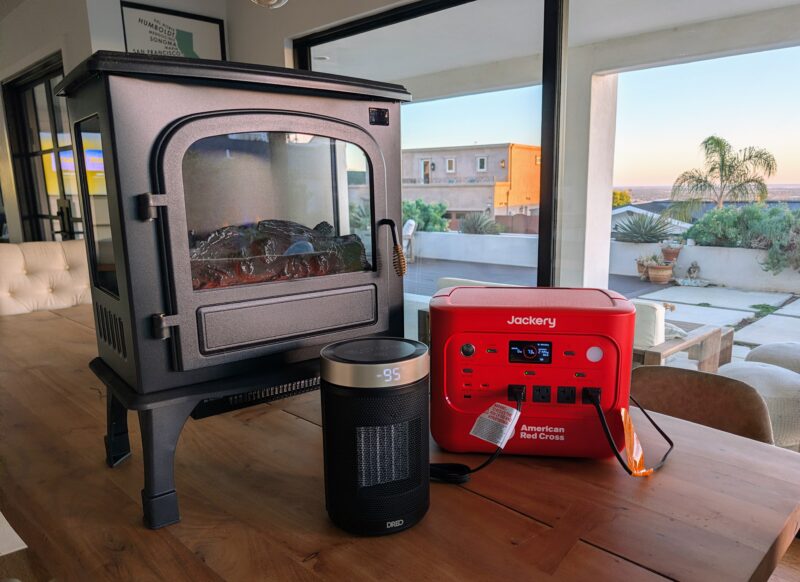
But we wanted more. So we brought out some new winter warmers and really made the Jackery sweat. Each of these heating units can draw up to 1500 watts each, which is about the maximum you can get from a standard 15A outlet. We plugged both into the Jackery and turned them up to maximum. Personally, I’m thrilled to have more power-hungry appliances with which to torture (I mean test) portable power stations.
Playing with all of their settings, we had them draw almost 3100 watts consistently before Jackery finally decided to throw in the towel. It kept them running for several minutes at their own constant output power rating of 2400 watts, which was impressive, especially considering how compact it is.
In general
It’s exciting to see Jackery continue to move towards new battery technologies, but in this case, this is the same battery they sell as a regular unit, just rebranded to highlight the great work being done at the Red Cross and give back some of the profits in product form.
It’s worth celebrating, and it’s exciting to see Jackery leading the charge to bring technology to first responders without charging governments or consumers more money for the same product.
Or maybe you just like a bright red unit that will make it hard to lose or forget. Whether you’re going camping or coming home after a long week in the wilderness, the bright red color of this unit is sure to stand out.
To learn more about the Jackery HomePower 2000 Plus Red Cross Edition or purchase one for yourself, visit the official Jackery website.
Specs
- Battery capacity: 2kWh / 2048 Wh (40 Ah/51.2 V DC)
- Cellular chemistry: LiFePO₄
- Life cycle: 6000 cycles at 70%+ capacity
- Weight: 41.45lbs/18.8kg
- Dimensions: 14.4 × 10.0 × 10.7 inches / 36.6 × 25.5 × 27.2 cm
- Charging temperature: 14°F to 113°F / -10°C to 45°C
- Discharge temperature: 14°F to 113°F / -10°C to 45°C
- Warranty: 3 + 2 years
- Departure ports
- 4 × AC outlet: 120 V~ 60 Hz, 20 A max, 2400 W nominal per port
- Total AC Output: 2,400W in total, 4800W peak surge
- DC output: DC 12V port: 12V⎓10A max.
- 30W USB-C output: 30W max, 5V⎓3A, 9V⎓3A, 12V⎓2.5A, 15V⎓2A, 20V⎓1.5A
- 140W USB-C output: 140W max, 5V⎓3A, 9V⎓3A, 12V⎓3A, 15V⎓3A, 20V⎓5A, 28V⎓5A
- USB-A output: 18W max, 5-6V⎓3A, 6-9V⎓2A, 9-12V⎓1.5A
- DC expansion port: 36.8V-57.6V⎓55A max.
- Ports of entry
- Charging mode AC input: 100V-120V~ 60Hz, 15A max.
- Bypass Mode AC Input/Output: 100V-120V~ 60Hz, 15A max.
- DC input: 16V-60V⎓12A Max, Dual to 21A/800W Max, 11V-16V⎓8A max, double to 8A max
Sign up for CleanTechnica’s Weekly Substack to get in-depth analysis and high-level recaps from Zach and Scott, subscribe to our daily newsletter, and follow us on Google News.
Do you have any tips for CleanTechnica? Do you want to advertise? Want to suggest a guest for our CleanTech Talk podcast? Contact us here.
Subscribe to our daily newsletter to receive 10-15 new cleantech stories per day. Or sign up to receive our weekly newsletter on the week’s top stories if the daily grind gets too much.
CleanTechnica uses affiliate links. See our policy here.
CleanTechnica Comment Policy