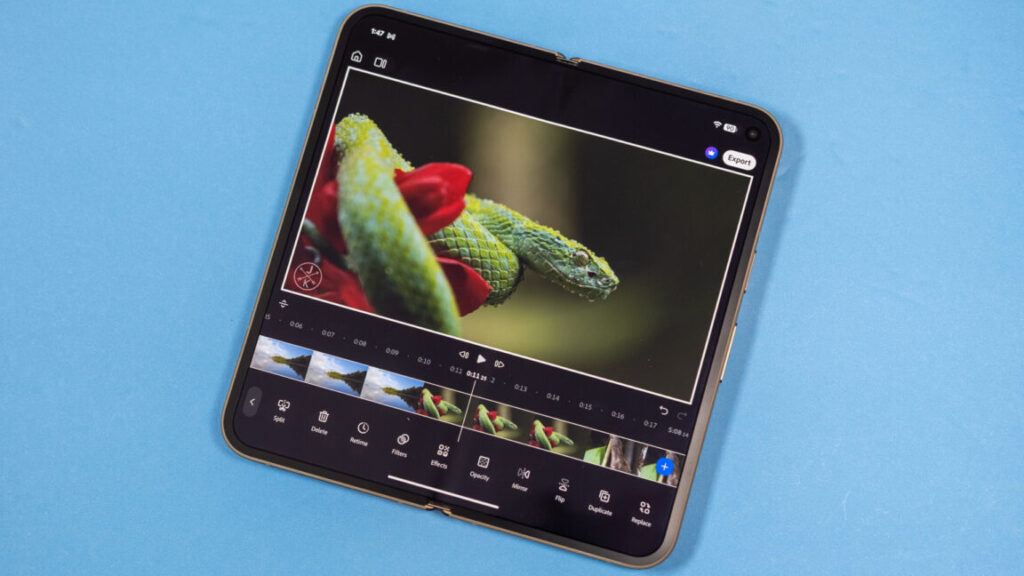
I tried Premiere importing several high bitrate 4K clips and it didn’t crash. However, processing newly added video tracks may take up to a minute. The export isn’t instantaneous either, but it’s faster than I expected on a Pixel, which isn’t exactly known for its extreme performance. A three-minute 4K60 video in high-quality mode took about three minutes. The app is designed to work on any Android device with at least 5 GB of RAM.
There are a good number of options in the editing interface; Unless you are a professional or enthusiast video editor, this app should be powerful enough. Adobe also says that Premiere (and the rest of its mobile app portfolio) is optimized for Googlebook laptops. If you need more, there’s always the full desktop version of Premiere. Of course, that won’t be an option on Googlebooks.
Premiere for Android is free and you don’t even need a subscription or Creative Cloud account unless you’re interested in generative AI tools. The new Premiere app has image-to-video and text-to-video conversion, with options for Adobe’s “commercially safe” Firefly model, as well as the Google Veo, Google Omni, Luma Ray, and Kling models.
You can generate some clips for free in Premiere, which comes with 250 monthly AI credits. That’s enough for a few Veo Fast clips (80 credits each) or a single Firefly video. For $70 per year or $8 per month, you get 1,200 monthly AI credits in the Premiere mobile app. If that’s not your thing, you can enjoy the free and vastly improved video editing experience on Android. Apple devices got this app last year, but “better late than never” has always been the Android app motto.