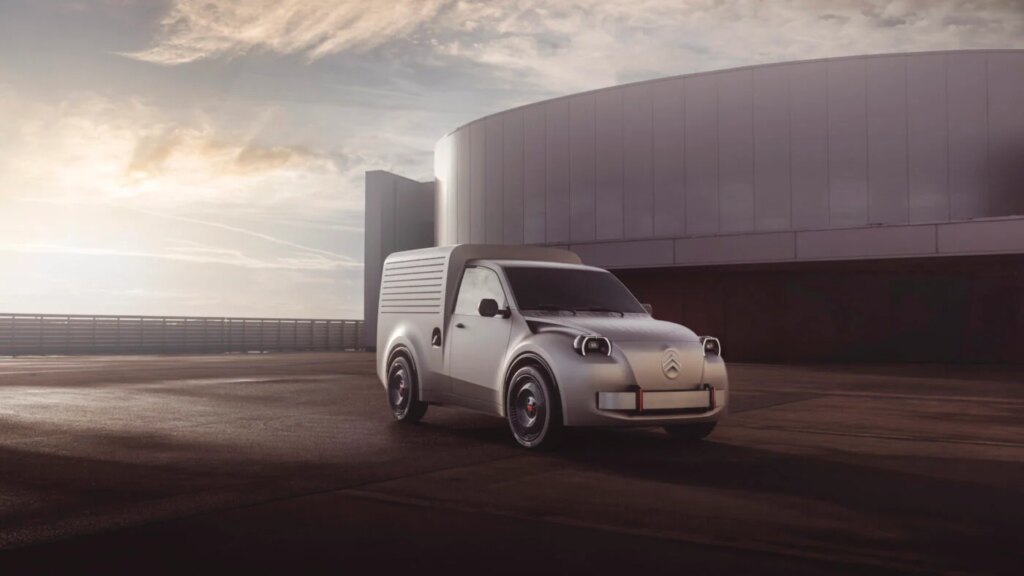
The new concept vehicle adopts the characteristic silhouette of the historic 2CV Fourgonnette, known in Germany as ‘Kastenente’. Citroën positions the study as a battery-electric work vehicle with the simplest possible operation, great everyday practicality and deliberately minimal technology.
The manufacturer has not yet published technical data for the study of the commercial vehicle. Details such as battery size, autonomy, charging power, payload or charging volume are missing, as well as a specific schedule for a possible production version. For commercial users, these figures are decisive, so the study remains, for now, primarily a design and concept perspective.
The new 2CV concept
Technically and conceptually, the Fourgonnette is based on the 2CV Concept, also presented in Paris. With this, Citroën aims to reinvent the 2CV as a particularly simple battery electric car. The concept, which measures around 3.76 meters long, is designed to operate with low weight, minimal equipment and a relatively small battery.
For a possible production model of the standard 2CV, Citroën is targeting a starting price of around 15,000 euros and a market launch in 2028. The manufacturer intends to position the vehicle between the Ami and the C3. It will also comply with the European regulations planned for especially compact and affordable battery electric cars. However, Citroën has not yet provided specific data on the battery, power or autonomy of this model.
This approach makes the Fourgonnette particularly interesting for the commercial vehicle market: instead of prioritizing long ranges and large batteries, Citroën focuses on low weight, simple technology and low costs. For urban delivery services, merchants or other commercial customers, this concept could fundamentally adapt to short and predictable usage profiles.
However, it is not yet clear if this will result in a production vehicle. The manufacturer explicitly describes the Fourgonnette as a design study and clarifies that it does not offer concrete short-term prospects for a production model.
For now, the key strategic question remains: Will Citroën later expand its new 2CV idea to include a battery electric commercial vehicle variant? If the manufacturer transfers its announced goal of low weight and low costs to a series-production light commercial vehicle, the Kastenente could become particularly relevant in areas where current electric vans are already too large and expensive for their intended use.
stellantis.com