Support CleanTechnica’s work through a Substack subscription, on Patreon, or on Stripe. Help us produce all the original, high-quality content we publish week after week despite the challenges of AI deleting content, anti-social media, inflation and other obstacles.
At a flashy GM Forward event in New York City on October 21, General Motors laid out its plans to remain relevant in the auto manufacturing business. (Never mind that the industry enjoys walled garden status in the United States, which has chosen to erect trade barriers that exclude sales of Chinese-made cars.)
There were many announcements at the GM Forward event, but the one that was probably the most important is that GM will pin its hopes on a new battery chemistry developed in partnership with LG Energy Solution called LMR, which stands for lithium-rich manganese.
If you’re not familiar with it, it’s because, as far as we know, no one else in the industry is using it. Everyone else is moving from nickel-manganese-cobalt (NMC) to less expensive iron-coated (LFP) batteries or sodium batteries that eliminate the use of lithium altogether. GM has decided to go in a different direction, and that decision will either pay dividends or push GM further down the slope toward bankruptcy.
It’s a bold strategy and signals that GM hasn’t abandoned the pursuit of electric vehicles. But we’ve seen this video before from a company that has changed its electric vehicle strategy several times. Is this the time for GM to stand firm and devise a successful EV strategy? Maybe…..
One third more energy density
The LMR battery is designed to offer 33 percent more energy density than lithium iron phosphate, which is expected to translate into longer range thanks to a smaller, lighter battery pack that costs about the same as one using LFP chemistry. At the GM Forward event there was no discussion about cold-weather performance or charging speeds.
We’ll have to wait for those details to emerge later.
In New York, GM President Mark Reuss told the assembled crowd: “This technology will appear in our highest-volume segments and is a great example of how we are bringing battery innovation to mass-market electric vehicles, with lower costs, longer range and improved performance. One in four vehicles sold worldwide is an electric vehicle. That number continues to rise. We are not going to move away from that. We are embracing it. We continue to develop our future electric vehicles and work to reduce battery costs. And When the US market is ready for electric vehicles in large quantities, we will be there to help them.”
Readers will note that GM doesn’t seem to believe the U.S. market is ready for electric vehicles yet. It has openly supported the recent reduction in tailpipe emissions ordered by the current administration, canceled most marketing efforts for its existing electric cars, and decided to stop production of the second-generation Chevy Bolt, again. Meanwhile, it plans to introduce a new generation of V-8 engines for its line of gasoline-powered behemoths. That’s why our readers have learned to take everything GM says with a grain of salt.
The company said it would normally take years to design and test the chemistry of a new battery, but thanks to the wonders of AI, its engineers were able to use computer models to test more than 300,000 battery designs before building a physical prototype. “The time between the first LMR battery pack concept and formal program approval was just one month,” the company said.
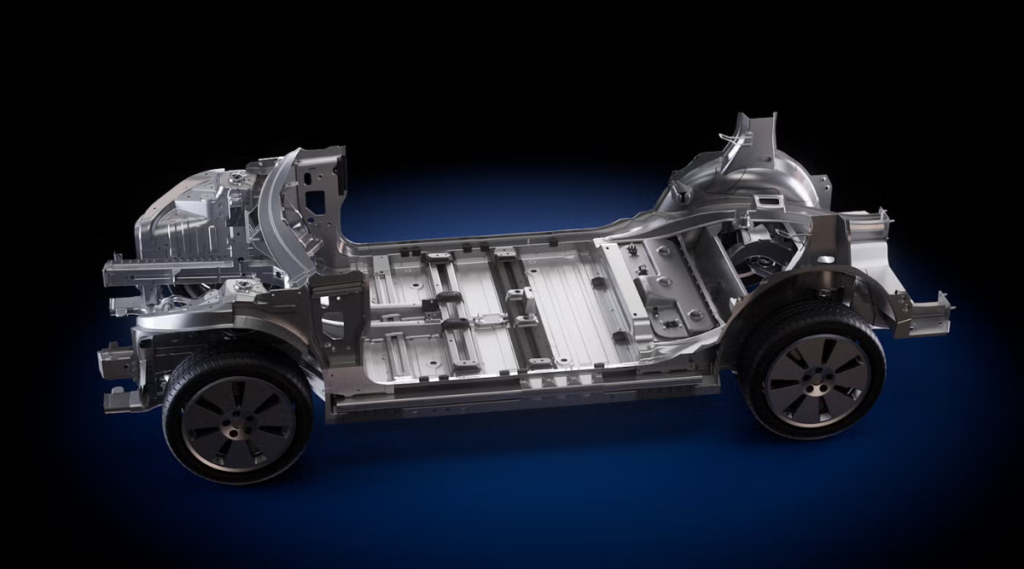
Fourth generation EV platform
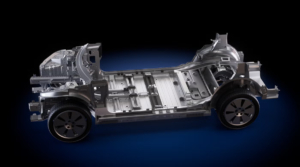
The battery is just one part of an electric vehicle. GM said this week that future electric vehicles will be built on its fourth-generation EV platform, which will use smaller, lighter electric motors. This will reduce production costs and provide more space inside for people and their belongings. It claims to have reduced the number of parts in each drive unit by 40 percent, making it cheaper and lighter.
Zonal architecture is the latest buzzword in the industry. Basically, it reduces the number of computers needed to control all of a vehicle’s functions, resulting in lower costs and more efficient operation. A typical passenger car today may have up to 80 computers that control acceleration and braking, steering, heating and cooling, fuel injection, etc. Deluxe models can have 150 or more computers. Rivian is a leader in the design of zone architecture systems and won a $5 billion contract with Volkswagen to teach the German company how to integrate the technology into its vehicles.
GM is doing something similar. He told reporters in New York that simplicity will be the key to optimizing his future electric vehicle models, which will have fewer control modules and 30 percent less wiring than current models. “Perception, propulsion, active safety and chassis controls will be consolidated into a single high-speed ‘Central Computing Unit’,” the company said. It claims its fourth-generation EV platform will also feature 40 percent faster processing speeds.
AI-powered production process
GM’s new AI prowess isn’t reserved for its electric cars, however. Thanks to a new AI-inspired production process, future manufacturing teams will be able to test production steps, review equipment placement, and identify safety or ergonomic issues before installing hardware on the assembly line. Called “PlantBrAIn,” it will combine factory data with computer models to improve the quality of new electric vehicles and battery packs. The process has already reduced the time needed to complete a battery pack by 30 percent.
GM says its new artificial intelligence tools will allow it to reduce new vehicle development times from 5 to 2 years. Designers, engineers and manufacturing experts will now connect with each other digitally from the first day of development to the start of production.
“We are replacing this completely sequential process with a new operating system based on large-scale data and simultaneous development. What we are building collapses design, engineering and manufacturing into a set of probabilistic optimizations that create better products in half the time,” said Sterling Anderson, GM’s chief product officer.
“In the era of AI, data is currency. Large companies like General Motors have a reputation for being big, for having a lot of inertia, for being slow. In the era of AI, the data and scale we have stops being a liability and becomes an advantage.” We certainly hope so, Sterling.
Central Computing Unit
General Motors is also in the midst of a race to develop autonomous vehicles, not only for electric vehicles but for all the models the company produces. Autonomy will be controlled by a newly developed Central Computing Unit.
“As we move toward a more autonomous future, it becomes what you need it to be when you need it: a genuine space to think, a space to plan, a space to recharge. It really extends your life on the road rather than stopping it until you reach your destination,” said Sebastian Bauer, the company’s head of human interface design. “None of this works without trust, and trust is not a feature. It’s a fundamental design principle, which means adapting to your conditions and needs, and being very transparent about the decisions the vehicle makes so you always understand why.”
GM made a lot of promises in New York this week. Now we will see if he can meet them. Frankly, the company has burned us too many times to fully trust its pronouncements. Will it match or even surpass its peers when it comes to making attractive cars, both conventional and electric? “We’ll see,” said the Zen master.
Sign up for CleanTechnica’s Weekly Substack to get in-depth analysis and high-level recaps from Zach and Scott, subscribe to our daily newsletter, and follow us on Google News.
Do you have any tips for CleanTechnica? Do you want to advertise? Want to suggest a guest for our CleanTech Talk podcast? Contact us here.
Subscribe to our daily newsletter to receive 10-15 new cleantech stories per day. Or sign up to receive our weekly newsletter on the week’s top stories if the daily grind gets too much.
CleanTechnica uses affiliate links. See our policy here.
CleanTechnica Comment Policy