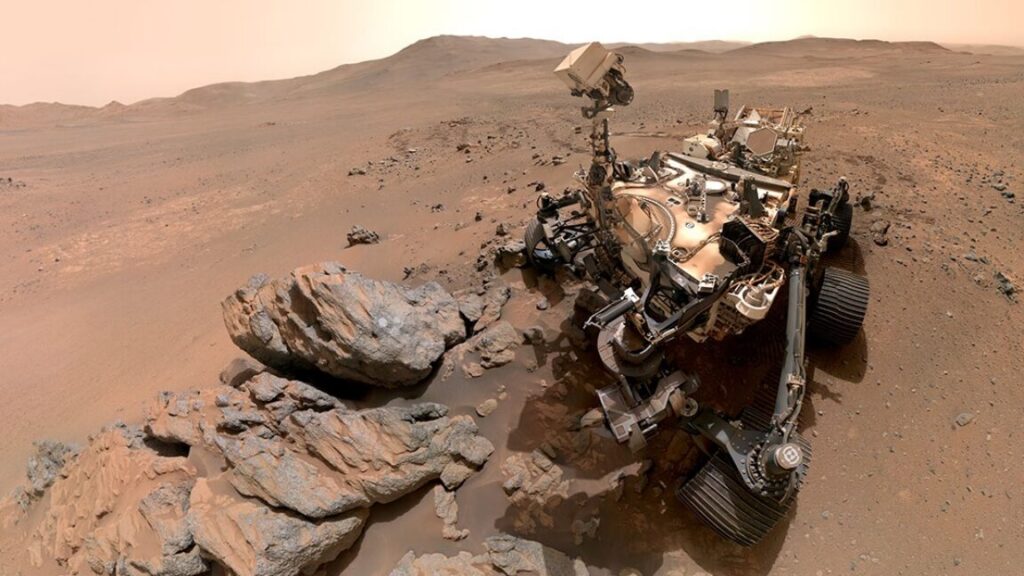
“The team hopes the rover can return to science by the end of November.”
The six-wheeled robot broke a record last month for the furthest distance ever traveled by a vehicle on another planet. The Perseverance rover has surpassed the 28.06-mile (45.16-kilometer) mark set by NASA’s Opportunity rover, which stopped operating in 2018. Perseverance’s odometer is now twice the rover’s original target for distance traveled.
Runs on fumes
The situation with the Odyssey orbiter appears to be worse. One of the four reaction wheels used to orient the spacecraft stopped spinning in early November, leaving Odyssey with two good wheels after the first failed in 2013. The Orbiter requires at least three wheels to maintain correct alignment.
“Without the three reaction wheels, the spacecraft must rely solely on its hydrazine thrusters to maintain orientation,” NASA said. The orbiter needs a stable orientation to point its solar arrays toward the Sun and its science instruments toward Mars.
Odyssey ran out of fuel before the reaction wheel malfunction, but managers were optimistic that with “extremely low” fuel consumption, the orbiter would have enough fuel to continue operations at least through the end of 2028, Jeffrey Plaut, Odyssey’s project scientist at JPL, said in a presentation earlier this year.
This assumed that the Odyssey’s three remaining reaction wheels did not fail. Engineers estimate that without three healthy wheels, the spacecraft has enough hydrazine fuel to survive for one to two months, NASA said. The good news is that ground teams have had initial success in troubleshooting the stubborn reaction wheel. Further testing is required to determine if the wheel is recoverable.
Aging infrastructure
Odyssey is one of four orbiters NASA uses to relay data between Earth and the Perseverance and Curiosity rovers on the surface of Mars. Curiosity is still driving and collecting data after 14 years on Mars. The other three relay ships are NASA’s Mars Reconnaissance Orbiter, which reached the red planet in 2006, the European Space Agency’s ten-year-old ExoMars Trace Gas Orbiter and ESA’s 23-year-old Mars Express spacecraft.