

“The abundance of things, even if they are good, means that they are not valued”
When we think of great philosophical reflections we go to Greek classics like Plato, but the truth is that we have very profound quotes from much closer geniuses. For example, by Miguel de Cervantes.
And the Spanish writer left a reflection that is still relevant about the value we give to things in the prologue of the second part of Don Quixote: “The abundance of things, even if they are good, means that they are not valued”.
And Miguel de Cervantes is not only talking to us about money, but about the way excess can make invisible even that which has value. He wrote it at the moment he introduces Don Quixote and warns that he does not want to drag out the adventures of the gentleman forever.
Miguel de Cervantes argued that abundance ruins even what has value
In Don Quixote There are sayings that we still use and phrases that we should apply in our daily lives. This is the case of “The abundance of things, even if they are good, makes them not valued.”
In a few words, Cervantes relates the value of something and the ease with which we have it before us. When something is scarce, we tend to look at it more carefully.. When there is too much of it, even if it is good, we run the risk of stopping appreciating it.
Miguel de Cervantes does not say that what is abundant is bad nor does he despise what is good. What he defends is that repetition, excess or constant availability can reduce the esteem we give to things.
In fact, that’s what makes it fit so well with the idea that not all wealth automatically increases enjoyment. Sometimes, having something valuable too close ends up becoming a problem.
What does Cervantes’ quote in the prologue of ‘Don Quixote’ mean?
The reflection appears at the end of the prologue of the second part. Cervantes explains that he delivers a Don Quixote made by the same craftsman and the same fabric as the first, but he also warns that the character is finally dead and buried.
The reason is that Cervantes had seen how another author dared to continue the story of Don Quixote. That is why its closure has something of a literary defense and a definitive decision.
He doesn’t want anyone to continue raising new stories about his creature. Those already written are enough. These “discreet madnesses”, as he calls them, are enough without the need to enter into them again.
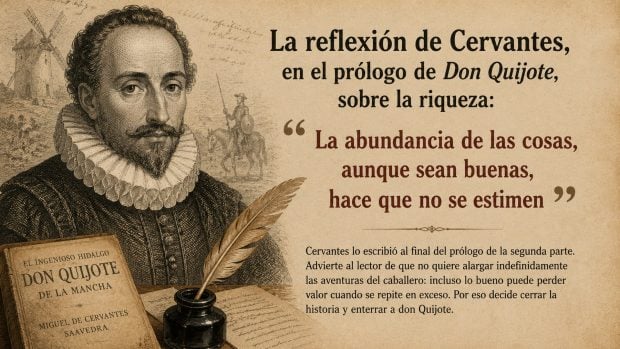 Cervantes quote.
And the fact is that “The abundance of things, even if they are good, makes them not valued” is a defense that, Even a character as brilliant as Don Quixote can end up exhausting the reader if it is multiplied without measure..
Who was Miguel de Cervantes beyond ‘Don Quixote’
Miguel de Cervantes Saavedra was born in Alcalá de Henaresprobably on September 29, 1547, and died in Madrid on April 22, 1616. His life was not that of a writer always locked between papers.
In fact, he participated in the battle of Lepanto in 1571, where he received wounds in the chest and hand, origin of the nickname Manco of Lepanto.
He also ended up imprisoned in Algiers. He was captured in 1575 while returning from Naples to Spain and spent almost five years in captivity, with several escape attempts.
Public The Galatea in 1585 and, of course, the first part of The Ingenious Gentleman Don Quijote of La Mancha in 1605 and the second in 1615. Between the two, the Exemplary novelsin 1613.