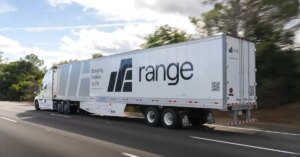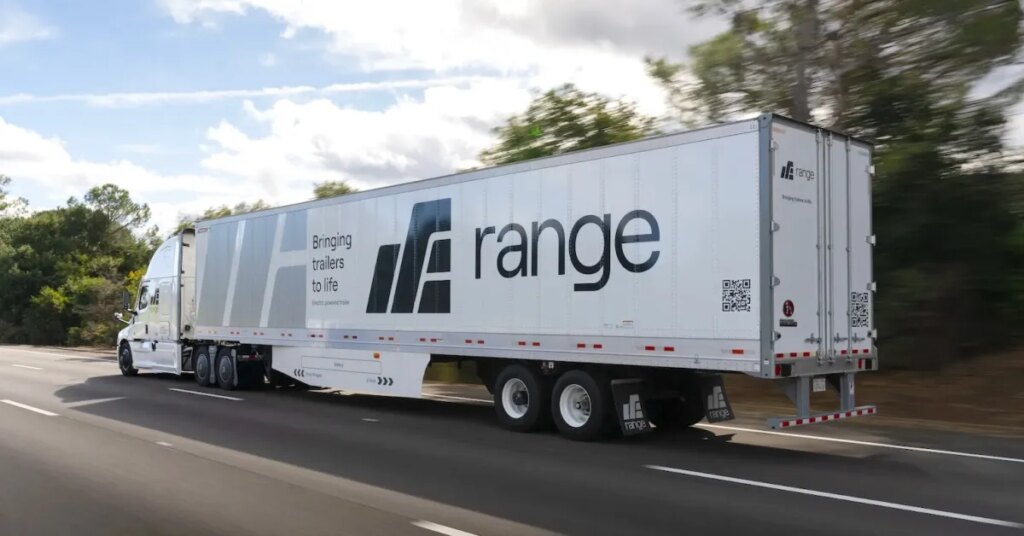
Range Energy, a company working to electrify road transport by using a trailer with its own battery and motors, has published an analysis showing how much fleets can save through electrification – and at just the right time, with diesel at record levels.
You may have heard something about diesel prices lately, which have nearly doubled in less than a year due to Donald Trump’s chosen war in Iran.
Diesel is now at record levels and is devastating fleets, truckers, and anyone who uses anything delivered by truck (i.e. everyone). It is an urgent problem that needs an urgent solution and the solutions do not come from the responsible entities.
Therefore, fleets have to look for another solution, and Range Energy would like to be the one to provide it.
Range is a California-based startup founded and comprised of former Tesla employees and others in the electric vehicle industry. It’s building an electrified trailer that we demonstrated at the ACT Expo in 2024 (seriously, check it out, it’s a cool demo) that promises to significantly reduce fleet fuel use.
To do this, it has its own battery and motors inside the trailer, which means that the tractor does not have to work as hard as the trailer can effectively pull its own weight. Although the tractor still runs on diesel, it consumes much less.
This differs from the other popular option for fleets: full electrification. There are several electric semi-tractors available and fleets have been moving to install them and prepare their depots for loading. But Range lets you bring your own tractor and electrifies the trailer instead.
Range previously published some of the early findings, showing a 36% reduction in fuel use in a test scenario. It also conducted a pilot program with an egg farm in California, which improved the fuel efficiency of the farm’s diesel fleet by 50% to 70%.
Now Range has published its own whitepaper showing the comparative savings fleets can achieve with its own solution, the eTrailer, or with Tesla’s solution, the all-electric Tesla Semi. The document does not cover the other electric semi-trucks available on the market today, just a showdown between Range and Tesla.
The analysis goes through several scenarios, focusing mainly on refrigerated trailer units (“reefers”), which is the first product on which the range focuses.
Trailer electrification is a great idea for reefer containers, because they are typically filled by volume rather than weight (called “cubing out”), meaning the weight of the battery does not affect the maximum payload of the trailer. The batteries also provide power to run the refrigeration, meaning there is no need to have a diesel generator in the trailer.
The upshot of all this is: fleets can save money with the Range eTrailer, and in theory they can save more money with the Tesla Semi, but the numbers are relatively close in the most common scenario, and Tesla’s scenarios are much broader in scope depending on the implementation being considered.
For example, if you only use public chargers instead of your own depot, the Tesla Semi will be more expensive because the power will be more expensive for your fleet than if you purchased it at commercial utility rates. So while installing chargers in your warehouse may seem expensive, it will work out better in the end.
The biggest money savings came from having two Semis sharing the same charger, but that requires tight schedules and night driving.
Another important characteristic that Range points out is the construction time of a project. The nice thing about the eTrailer is that it can be added to fleets straight away with few operational changes required, while the greater charging needs of an electric tractor tend to require larger projects to prepare a depot with chargers (but despite the higher upfront costs, there are better long-term savings as you avoid diesel altogether with an electric tractor).
In the end, Range found that its solution saves a little more money than the Tesla Semi in most scenarios, but the difference is pretty close and each option has its strengths and weaknesses. Both solutions are better than diesel in most scenarios, but not all.
There is no need to choose between the two, as an electrified trailer can also be used with an electric tractor. It works the same way in either case: it uses its own engines to relieve some of the effort from the tractor. This means extended range, for longer runs with light loads that couldn’t match the Tesla Semi’s inherent range. And the benefit of being able to operate the refrigerator while disconnected from the tractor or ground is also maintained.
The analysis has many limitations. It has to estimate future diesel costs (it used a number below current prices, but still historically high), it didn’t cover financing costs, it doesn’t have real-world data for the Tesla Semi, it didn’t cover electrified tractor or trailer options from other companies, it can’t analyze individual charging costs from site to site since each is utility-specific, it didn’t cover the myriad incentives available in various regions, and above all, it didn’t consider diesel emissions, which are a huge social cost for everyone. that electrification reduces (and total electrification reduces more).
So in the end, each fleet has a different use case and they should run the numbers themselves to see how any of the solutions would fit. But in the general case, it seems there are a lot of savings available, whether through tractor or trailer electrification.
Unfortunately, given that diesel prices are at record levels, right? nowboth options in the document are a bit suboptimal. Tesla Semis have been on order for almost ten years, and Tesla has just claimed that it has begun production in earnest. And Range is still about a year away from volume production of its eTrailer, which it says will begin in late 2027, so while an eTrailer will be able to join a fleet immediately when availableIt is not yet available, which puts a stop to that potential benefit.
So neither can offer immediate relief, but both offer good options for fleets to plan for the next inevitable oil crisis, which is why Range didn’t base its analysis solely on current prices (remember, fair I had another shock in 2022, this nonsense happens all the time, maybe it’s time to stop using oil). But the numbers in the Tesla Semi article can be compared to the numbers for other electric tractors already available today, which in turn can be compared to the costs of the eTrailer, for fleets so inclined to make that comparison.
Check out the full Range whitepaper below, with much more detail than we can cover in this article:
Charge your electric vehicle at home using rooftop solar panels. Find a reliable, competitively priced solar installer near you at energywisefree. They have pre-vetted installers competing for your business, ensuring high-quality solutions and 20-30% savings. It’s free, with no sales calls until you choose an installer. Compare personalized solar quotes online and receive guidance from unbiased energy advisors. begin here. – advertisement*
FTC: We use automatic affiliate links that generate income. Further.