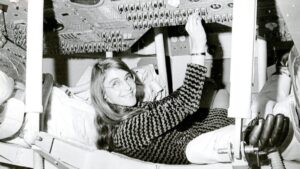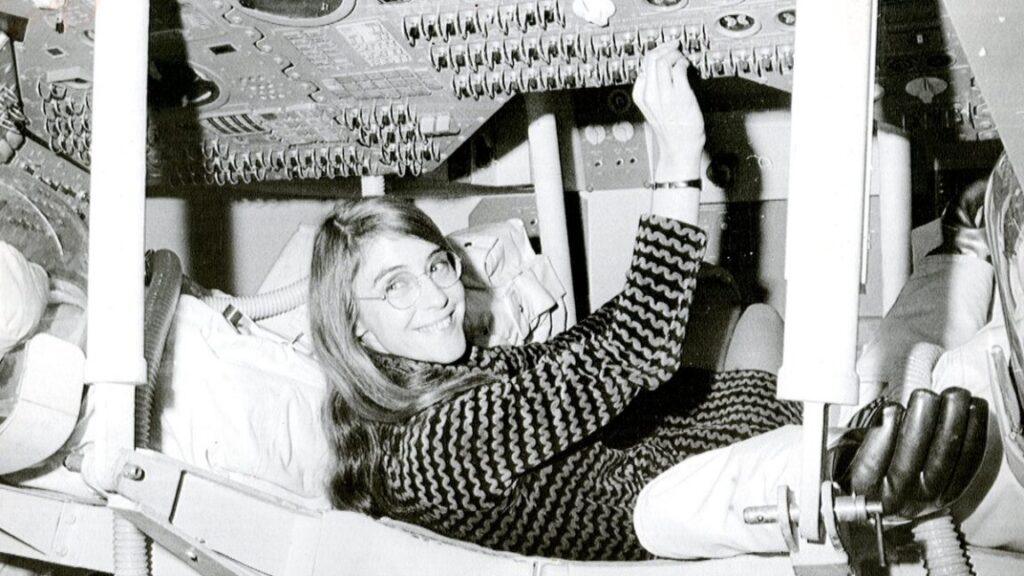
Hamilton often brought her four-year-old daughter, Lauren, to the lab on evenings and weekends. The kid loved pretending to be an astronaut in the simulators, and one day randomly pressing buttons caused the system to crash inexplicably. Apparently Lauren had entered “P01,” a pre-launch sequence, in the middle of the mission. Hamilton asked NASA if it could add a safeguard to prevent this from happening on an actual mission, but superiors didn’t take it seriously. Then astronaut Jim Lovell actually made this mistake during the Apollo 8 manned mission to orbit the moon, which resulted in the navigation data disappearing. Hamilton was called in to retrieve the data, jokingly referring to it as the “Lauren bug.”
By 1968, Hamilton was deputy director in charge of the Command and Service Module team. Hamilton had the idea of incorporating a failover into the system software’s “priority indication” interface routines in case the onboard control computer became overloaded with more tasks than it could handle in real time.
President Barack Obama awarded Hamilton the Presidential Medal of Freedom in 2016.
President Barack Obama awarded Hamilton the Presidential Medal of Freedom in 2016.
Image credit: Public Domain
That’s exactly what happened during the historic Apollo 11 mission in 1969. As the lunar module Eagle approached the moon, Buzz Aldrin entered the codes to display the altitude and other relevant data on the screen. The onboard computer began flashing alarms, forcing Mission Control to consider aborting the landing. Hamilton’s failsafe meant that the computer prioritized essential tasks and canceled non-essential tasks, and the alarm was intended to inform the astronauts that this was happening. Thanks to Hamilton’s foresight, Eagle still landed safely on the Sea of Tranquility.
As Hamilton himself later recalled in a 1971 letter:
The computer (or rather the software within it) was intelligent enough to recognize that it was being asked to do more tasks than it was supposed to perform. An alarm was then triggered, which meant to the astronaut: “I am overloaded with more tasks than I should be doing at this time and will only deal with the more important tasks.” i.e. the ones needed for landing… Actually, the computer was programmed to do more than just detect error conditions. A complete set of recovery programs has been integrated into the software. The software’s action in this case was to eliminate lower priority tasks and restore the more important ones… If the computer had not recognized this problem and taken recovery measures, I doubt that Apollo 11 would have been the successful moon landing that it was.
The Apollo software she co-developed was added to GitHub in 2015. In 2019, Google celebrated the 50th anniversary of the moon landing – and Hamilton’s crucial contribution – by training over 100,000 mirrors at its solar farm in the Mojave Desert to create a giant portrait of Hamilton in reflected moonlight.