An elusive recipe
In 2020, Dutch researchers reproduced the green/red dichroic effect of the Lycurgus Cup in a 3D printable nanocomposite material by embedding small amounts of silver and gold nanoparticles of the correct size and shape. But no one had yet developed a consistent, reproducible recipe. University of Sheffield scientists Lisa Hollands and Caroline Jackson – the latter an expert in Roman glass – worked together to develop one, experimenting with different kiln types, materials, oxygen levels and, at some point, incorporating sugar into the mix.
“I knew that making a glass of this type would probably be a complex task because it doesn’t just involve adding nanoparticles to the glass,” said Hollands. “I’ve been working with glass for over 25 years, so I’ve used the knowledge and experience I’ve gained in conjunction with a modern scientific understanding of what I wanted to achieve – although if the Romans had been able to watch me experiment, they’d probably laugh and ask, ‘Why doesn’t she know how to do that?'”
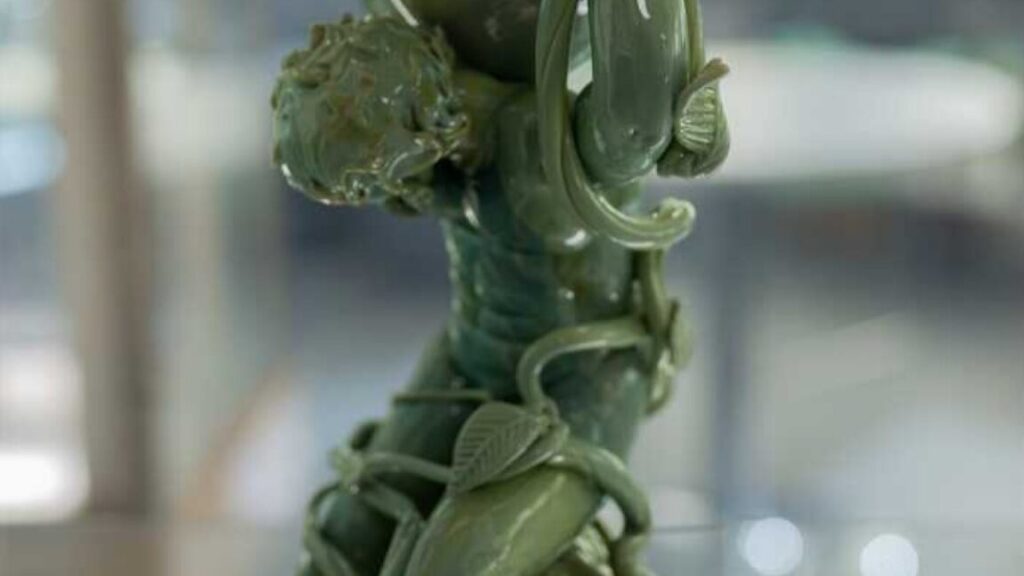
A contemporary glass sculpture paying homage to its intricate antique glass twin made at the Sheffield Smelter
Ed Cartledge, Art of Films
A contemporary glass sculpture paying homage to its intricate antique glass twin made at the Sheffield Smelter
Ed Cartledge, Art of Films
British glass artist Elliot Walker created the new piece using the Sheffield recipe
Ed Cartledge, Art of Films
British glass artist Elliot Walker created the new piece using the Sheffield recipe
Ed Cartledge, Art of Films
A contemporary glass sculpture paying homage to its intricate antique glass twin made at the Sheffield Smelter
Ed Cartledge, Art of Films
British glass artist Elliot Walker created the new piece using the Sheffield recipe
Ed Cartledge, Art of Films
The experimentation paid off when Hollands found a mixture that produced glass with the desired optical effects, appearing green in reflected light and red in backlight. Her first glass piece was exhibited at LightFest, part of Molecular Photonic Breadboards, a British project aimed at developing new materials that harness the power of light for sustainable technologies. Next, project leaders decided to commission British glass artist Elliott Walker – Netflix’s S2 winner Blown away Competition – to create a contemporary sculpture in homage to the original Lycurgus Cup.
“It is a very rare opportunity to work with glass made from ancient blends and recipes and it is always very exciting,” Walker said. “You can really get an idea of how the glassmakers of the past would have adapted to this type of glass; it’s like shaking hands with them. I wanted to keep the shape of the sculpture more classic and retain the original story of Lycurgus depicted on the cup, but we needed a blown element in it to really show off the dichroic glass. The piece is a mix of the Lycurgus story and the Farnese Atlas sculpture, with the globe was replaced by a cup.”
The public will get the chance to see Walker’s sculpture in person when it is unveiled at the Millennium Gallery during the University of Sheffield’s Festival of the Mind next month. It will then be on permanent display in the university’s Turner Museum of Glass.