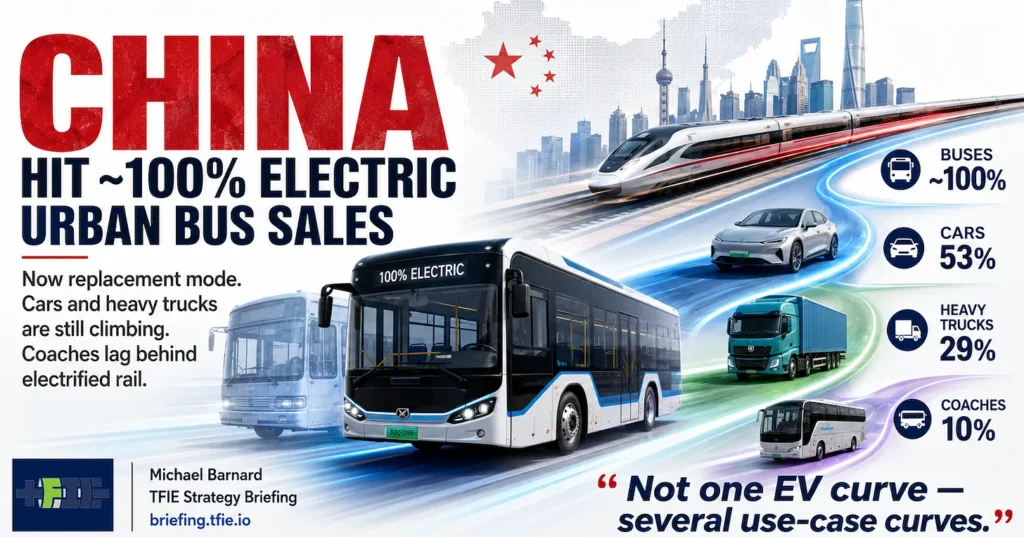
China has reached a stage of vehicle electrification that is easy to overlook if the only number being looked at is domestic EV market share. The new city buses are now essentially fully electric, and in many cities the purchasing question is no longer whether to replace a diesel bus with a battery-powered bus. It’s about which new electric bus should replace the electric bus purchased during China’s first big wave of electrification.
This is a more important milestone than another record year for electric vehicle sales because it shows a transportation segment completing its first adoption cycle and entering routine substitution. The International Energy Agency estimates that almost 70% of China’s more than 680,000 electric buses were already deployed before 2020, so a significant part of the current market consists of older electric fleets being renewed rather than diesel fleets being converted for the first time.
China’s 2025 equipment renewal program explicitly supported the replacement of new energy city buses and even the complete replacement of traction batteries, and the program will continue until 2026. Politics is still involved, but its task has changed. It is supporting renewal within a market where electric propulsion has already become the common technology.
That replacement cycle is the starting point of my TFIE Strategy Briefing analysis of China’s electric transportation markets. A look at buses, cars, heavy trucks and coaches shows why “China’s electric vehicle adoption rate” is increasingly the wrong denominator.
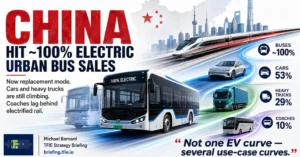
The passenger cars are at a different point. Electric cars accounted for just over half of Chinese new car sales in 2025, and buyers had nearly 700 electric models available by the end of the year. The IEA estimates that almost 70% of battery electric cars sold in China were cheaper than comparable conventional cars even before the incentives, meaning electric propulsion is no longer a niche alternative for Chinese car buyers. It is one of the normal options in much of the market.
Heavy trucks trail cars in absolute market share, but they move much faster. Electric heavy trucks will reach around 29% of Chinese sales in 2025, about double their share in 2024. Their strongest markets are not random: ports, mines, steel plants and industrial logistics operations offer trucks relatively predictable routes, high utilization and places where charging or battery swapping can be organized around work.
This is what makes commercial vehicles especially interesting. A private car may spend most of its life parked, so fuel savings add up relatively slowly. A hard-working truck can travel enough miles that lower energy and maintenance costs impact the business case much more quickly, especially when infrastructure can be concentrated in depots or along fixed corridors.
Intercity coaches demonstrate why even this logic cannot be extended to all categories of transport. Battery electric coaches accounted for only about 10% of Chinese coach sales in 2025, even though sales grew strongly from the previous year. At first glance it seems like a category far behind city buses. The difference is not simply that trainers need larger batteries. They compete with another electric technology that China expanded decades before most countries: railroads.
China ended 2025 with more than 50,000 kilometers of high-speed trains, while its rail system made more than 4.5 billion passenger trips during the year. High-speed rail reaches almost all Chinese cities with more than half a million urban residents, offering trips of one to two hours through many 500-kilometer city clusters and trips of about four hours through some 1,000-kilometer corridors.
A battery coach can replace a diesel coach on routes where road transport still makes sense, but it does not have to cover all long-distance passenger journeys that would otherwise have been made by bus. Some of that mobility has already shifted to an electrified mode with better performance in dense intercity corridors.
This is why national EV percentages can obscure more than they clarify. City buses, passenger cars, heavy trucks and coaches have wheels and batteries, but their economics are very different. They operate for different numbers of hours, return to different locations, transport different loads, use different infrastructure and face different alternatives.
A useful forecast starts with the work being done, not a single adoption curve. Fixed-route city buses were electrified early because the batteries matched the duty cycle and public procurement could coordinate charging. Passenger cars followed as battery costs fell, model choice expanded and purchase prices became competitive. Heavy duty trucks are now accelerating and their high utilization turns operational savings into a strong business incentive.
Coaches will also be electrified, but their addressable market is determined by what rail has already captured. That is not a weakness in the story of transportation electrification in China. It is proof that the goal is mobility with fewer fossil fuels, without forcing all existing vehicle categories to grow into an equally large electric market.
There is also a caveat about which data is worth preserving. Chinese sources have historically used overlapping categories, such as “new energy buses,” and successive editions of the IEA have revised classifications as better data became available. The precise shape of the first bus curve is less certain than the general pattern: city buses moved first and are now saturated, cars are mainstream, heavy trucks are rising rapidly, and coaches remain much less electrified.
For policymakers outside China, the implications are practical. A country with a low national share of electric vehicles should not assume that all transportation segments will grow at the same rate. Some categories can move very quickly once the vehicles, operating economics and infrastructure align, while other categories can remain smaller because another mode does some of the work better.
That changes how public money should be spent. Instead of subsidizing all EV categories equally, governments can identify the uses where electrification already fits, remove infrastructure bottlenecks, and allow those markets to move forward first. Buses, depot-based fleets, high-utilization trucks, and other predictable business applications often provide clearer starting points than trying to move an entire transportation sector forward together.
China’s experience suggests that the mature end point will not be a smooth EV adoption curve. Several different transitions will unfold depending on the work each vehicle performs and the transportation systems around it.
TFIE’s comprehensive strategic report compares the sales trajectories of Chinese city buses, passenger cars, heavy trucks and coaches, including why high-speed rail changes the denominator for coaches and why replacement, rather than first adoption, now drives much of the city bus market.