Support CleanTechnica’s work through a Substack subscription, on Patreon, or on Stripe. Help us produce all the original, high-quality content we publish week after week despite the challenges of AI deleting content, anti-social media, inflation and other obstacles.
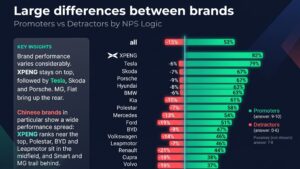
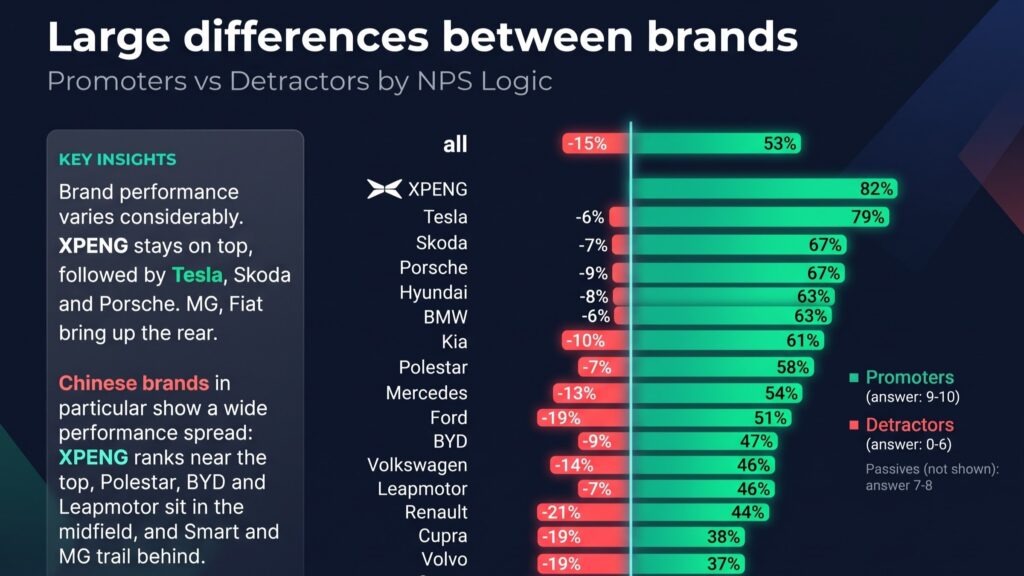
XPENG recently ranked highest in the European USCALE “Electric Vehicle Satisfaction Study” for the second consecutive year. XPENG not only topped the list again, but its score improved from the previous year. The leading recommendation rate of 82% is significantly above the industry average of 53%, positioning XPENG ahead of all US, European and Asian manufacturers.
The Stuttgart study surveyed more than 4,000 customers from Germany, Austria and Switzerland. The USCALE consulting firm uses the Net Promotor Score (NPS) methodology that analyzes factors such as loading speed, reach, and general product characteristics. While other brands had a varying proportion of detractors, XPENG only had promoters. XPENG ranked above average in all categories and customers were particularly satisfied with charging performance, charging management, range and application integration.
While XPENG topped the charts, electric vehicles are driving greater overall customer satisfaction, with Tesla coming in second. But customer expectations are evolving. As Dr. Axel Sprenger, founder and CEO of USCALE GmbH, explains:
Electric vehicle drivers are more satisfied than ever. But they are also increasingly demanding. What was exciting yesterday is standard today. Manufacturers have done their homework in terms of autonomy and charging. Now, the competition is decided by software, connectivity and a seamless charging experience. Those who do not deliver here will be left behind, and this is clearly seen in the standings.
As part of the shift in expectations, not all EV brands have risen above the competition and some previous leaders have been knocked off the top. As pointed out and caesarFounder, GLOBAL Electric Vehicles:
We are often asked what the best battery electric vehicles on the market are, but our subjective opinion is significantly outweighed by the actual experience of electric vehicles for sale in the mass market. Germany’s USCALE survey showed once again in 2026 which brands are best regarded by electric vehicle drivers; the differences are marked. In particular, Opel, Fiat and MG are the worst performers. Meanwhile, while Tesla has long been considered “the brand to beat,” it finished behind fellow tech leader XPENG for the second year in a row, although well ahead of other Asian brands. What’s more, at the recent Paris Motor Show, XPENG demonstrated beyond a doubt that its NGP autonomous driving capability is directly comparable to Tesla’s much-hyped FSD technology. With strong sales in Europe, we believe many English-speaking countries are sleeping on XPENG’s potential and once its full range of EVs are on sale in all territories, it will be the one to watch.
A manifestation of XPENG’s human approach to technology
XPENG didn’t make it to the top of these rankings by chance. It is a manifestation of a more human approach to technology that permeates the entire company, from its employees to its services and products.
Some Chinese automakers have adopted the strategy of reserving their latest technology for the domestic market, while bringing older technology to Europe. Models introduced as “new” in export markets may already be discontinued in China. While using older platforms can save costs and might be good enough to compete in Europe, customers are not getting the best available. Additionally, many other automakers are raising prices well beyond the cost of importing the vehicles.
XPENG is taking a different approach. They are launching their latest models with their most advanced technology worldwide. In terms of intelligent driving, XPENG will soon have the most comprehensive system. It was designed from the beginning to be global and comply with anticipated UN DCAS regulations, while adapting to different driving circumstances around the world. Those local driving circumstances are determined as much by the customs of human drivers as by any rules. And XPENG isn’t marking up products and technologies much more than necessary to cover the taxes, tariffs, and other associated costs. Making the best technology available at an affordable price helps increase customer satisfaction. Ensuring that technology meets the needs of each customer where they live increases satisfaction even further. When I interviewed him in Paris, I asked the president, CEO and co-founder of XPENG He Xiaopeng to explain the strategy (automatically translated with Google):
Let me start by saying this: who wouldn’t want the best technology at a reasonable price, right? As a product manager with a technical background, I have always been driven by the desire to bring superior technology to as many people as possible, at a fair price. For the past six or seven years, our approach to autonomous driving at XPENG has been guided by a core philosophy: how can we deploy our technology globally without needing to manually collect high-definition maps or codify region-specific driving rules for each location? Instead, we aspire to a system capable of generalizing across the diverse driving habits found around the world, habits that go beyond mere laws and regulations. This is the focus of much of our work. That’s why you see us currently carrying out tests in Europe and beyond; We aim to launch our next generation NGP (navigation guided pilot) in the European market next year. This is the culmination of the foundation we have built over the last six or seven years and I am really excited to bring our best technology to European customers at an affordable price.
Based on its focus on the human side of technology, XPENG has dedicated much of its work to adapting its technology to local culture, customs, rules and needs. When people feel respected, satisfaction increases. When technology addresses human needs, people are more satisfied with the technology. Technology adds value. Additionally, XPENG has been expanding local development and localizing manufacturing. XPENG has also partnered with companies like Volkswagen to supply technology and is integrating technology from companies like Google into its systems. I asked He Xiaopeng about the value found in different cultures and perspectives and how he sees this influencing the evolution of technology:
This is probably due to aspects of my own personality. I believe the world encompasses a wide range of cultures and technologies; For any given context, the “best” solution is the one that is well suited to that specific environment, and the basis for this must be mutual respect. From there, we can build trust, achieve a genuine win-win outcome, and create long-term, mutually beneficial value. In this framework, I have always maintained that European companies in China and Chinese companies in Europe must learn from each other, trust each other and collaborate. The idea of a winner-take-all scenario, where one side wins and the other loses, is something I’ve never subscribed to. Precisely for this reason, as XPENG expands into Europe, I believe our success depends on working together; It cannot be a matter of one party prevailing at the expense of the other. This has been my guiding philosophy for many years: When you enter a new market, consider what others expect of you: They expect a friend. For me, friendship is the most important thing of all.
XPENG cannot rely on a long track record to influence customer opinion. Customers will not show support for the brand based on memories of their youth. Many may not be familiar with XPENG as a company or its vehicles and technology. Many Europeans outside of enthusiast circles may not even have heard of XPENG or other newcomers to an automotive market that has traditionally been dominated by brands going back generations.
As such, they need to focus on their customers. They need to meet and exceed expectations. They need to make friends.
High customer satisfaction is not always immediately reflected in quarterly sales results. However, it creates friendships and creates advocates for your brand. Those advocates then talk to their friends and influence long-term purchasing decisions. Friends of the brand are more likely to buy that brand in the future. Technology implementation and market response can be rapid, but customer ecosystems must be built over time. By offering the best technology to global markets and focusing on the needs of its customers, XPENG not only tops customer satisfaction surveys. By focusing on long-term customer relationships, XPENG is setting itself up for long-term success.
Sign up for CleanTechnica’s Weekly Substack to get in-depth analysis and high-level recaps from Zach and Scott, subscribe to our daily newsletter, and follow us on Google News.
Do you have any tips for CleanTechnica? Do you want to advertise? Want to suggest a guest for our CleanTech Talk podcast? Contact us here.
Subscribe to our daily newsletter to receive 10-15 new cleantech stories per day. Or sign up to receive our weekly newsletter on the week’s top stories if the daily grind is too much.
CleanTechnica uses affiliate links. See our policy here.
CleanTechnica Comment Policy