
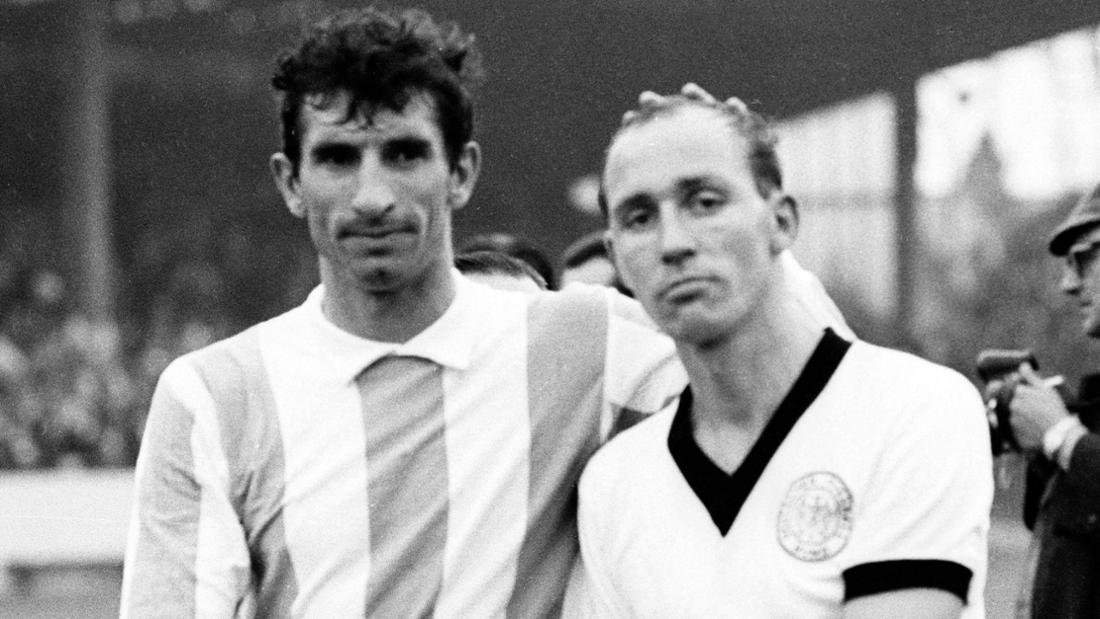
Argentina legend dies shortly before World Cup game
Follow us on Google
Antonio Rattin is dead. The Argentine football idol died at the age of 89. His sending off at the 1966 World Cup changed world football forever.
Buenos Aires – A name that is inextricably linked to one of the strangest moments in World Cup history: Antonio Rattin, captain of the Argentine national team and idol of Boca Juniors, died on Saturday at the age of 89. Shortly before Argentina’s World Cup quarter-final against Switzerland, his former club confirmed the news on its social media channels – triggering a wave of sadness across Argentina.
“It is with great sadness that we say goodbye to Antonio Ubaldo Rattin, the idol and figurehead of our club,” wrote Boca Juniors. The club for which Rattin played exclusively from 1956 to 1970 is mourning the loss of a figure who made history far beyond the football field. In 353 competitive games he won four championships and a national cup with the blue and yellow – a record that made him a club legend.
World Cup 1966: Rattin’s expulsion marked the birth of the red card
What made Rattin immortal happened in the quarter-finals of the 1966 World Cup in England. The Argentines met the hosts, who ultimately won the game 1-0. The Stuttgart referee Rudolf Kreitlein had already verbally warned Rattin several times – but the language barrier made any communication impossible because Kreitlein did not speak Spanish. When Rattin insulted the referee again, he sent him off the field.
Insights from the DFB team!

Be closer to the DFB team than ever before! Our World Cup newsletter provides you with the most important news; delivers to you Videos, reports and exclusive interviews directly and conveniently to your inbox. You will find out what will be important throughout the day, you can win great prizes in our betting game and you will get all the social media highlights prepared.
Are you there?
Register now for the World Cup newsletter
All of our content, videos, graphics, statistics and much more is also available on absolutfussball.com.
Rattin called for an interpreter and refused to leave the field for several minutes. In the end, English police had to intervene. As he left the lawn, Rattin crumpled an English flag – and sat down ostentatiously on the red carpet laid out for the Queen. FIFA drew its conclusions from the chaos: As a direct result of this scene, the world association introduced yellow and red cards. Rattin had, without meaning to, changed the rules of world football.
Rattin played a total of 34 times for the Argentine national team and took part in two World Cups – 1962 in Chile and 1966 in England, where he served as captain. After his playing career, he worked as a coach, including at Boca Juniors, and became involved in politics. From 2001 to 2005 he served as a member of a small conservative party in the Argentine Chamber of Deputies.
What most obituaries hardly shed light on: Rattin was the first footballer to ever enter the Argentine Congress – a chapter of his life that has almost completely disappeared in public memory behind the 1966 World Cup scandal. It shows how complex this personality was, who shaped football and then looked for a new stage.
Rattin died on a Saturday – of all days on which Argentina is on the world stage in the World Cup quarter-finals against Switzerland at the current 2026 World Cup tournament. The death of the man who once enforced the rules of world football came at an hour in which his country is fighting for World Cup glory again. A coincidence that could hardly be more symbolic. (ck)