Support CleanTechnica’s work through a Substack subscription, on Patreon, or on Stripe. Help us produce all the original, high-quality content we publish week after week despite the challenges of AI deleting content, anti-social media, inflation and other obstacles.
The current European Renewable Energy Directive requires renewable fuels of non-biological origin, or RFNBO, to account for at least 42% of relevant industrial hydrogen use by 2030 and 60% by 2035, subject to exclusions and flexibilities. Those provisions do more than subsidize hydrogen production. They create a specific market for a specific class of molecule.
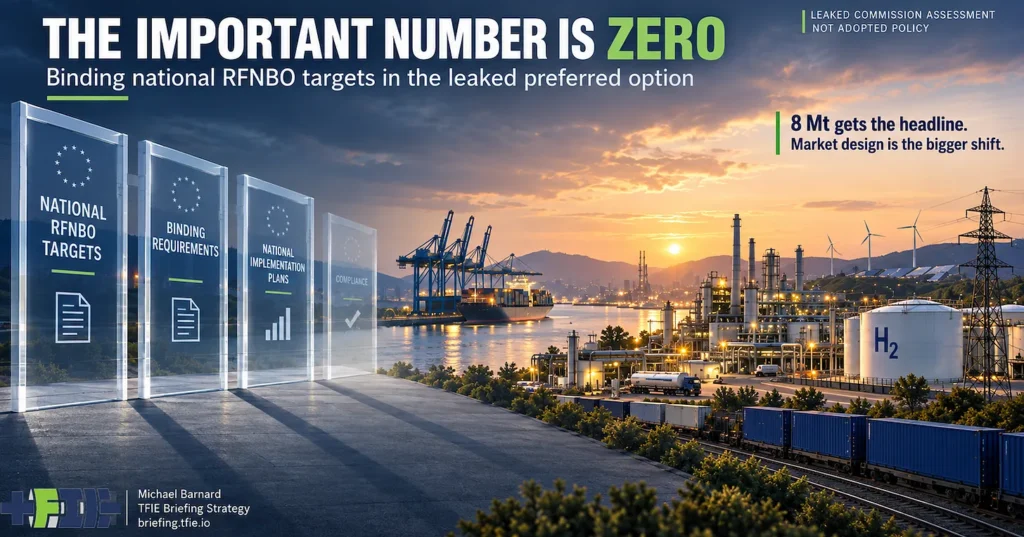
An impact assessment leaked by European Commission staff points towards a different architecture after 2030. Under the L2 measure included in the draft preferred package, RFNBO’s binding national consumption targets would disappear. Instead, there would be an indicative renewable hydrogen target at EU level, financing and enabling measures, and a credit mechanism aimed at creating demand without requiring all member states to replicate the same hydrogen market.
This remains a draft, rather than an established European policy. The document contains gaps and unresolved methodological material, while the Commission is still preparing the post-2030 renewable energy framework for a legislative proposal expected before the end of 2026. The useful question is therefore not what Europe has decided, but what the preferred option reveals about the direction that Commission staff are considering.
The full analysis in the TFIE Strategic Report follows changes when compliance support can move through credits rather than being linked to national hydrogen consumption quotas. The deeper question is whether Europe can continue to create demand for decarbonization while allowing evidence to change which hydrogen applications, projects and locations receive that demand.
The leaked evaluation also contains a major numerical reset. Its central scenario models a consumption of 18 million tons of electrolytic hydrogen in 2040, compared to eight million tons in the low hydrogen case and 20 million tons in the high case. The low-hydrogen pathway would require around 340 TWh of renewable electricity, about 335 TWh less than the baseline scenario, and the assessment notes that lower demand for electrolysis could reduce electricity prices and leave more clean electricity available for direct use.
This is very relevant to the electrification debate because hydrogen and direct electricity often compete for the same renewable generation. An electrolyzer converts electricity to hydrogen with significant energy losses before considering compression, storage, transportation or reconversion. Electric motors, heat pumps, furnaces, batteries, and direct electric industrial processes can often use the original electricity without that conversion chain. The leaked assessment does not clarify where the hydrogen belongs, but reducing the prescribed consumption of hydrogen changes the amount of electricity that must be reserved to produce it.
There is an important distinction between hydrogen as an existing industrial feedstock and hydrogen as a policy-selected energy carrier. Ammonia, refining and chemical processes already consume hydrogen, most of it produced from fossil fuels, so requirements that reduce the carbon intensity of the hydrogen needed can address an existing emissions problem. A technology-specific consumption requirement takes on greater consequences when it creates demand for hydrogen in applications where other technologies can provide the underlying service.
The current architecture limits some of that competition. Once regulation requires a particular proportion of qualified hydrogen to be consumed, market competition may determine which supplier provides that hydrogen, but has less influence on whether hydrogen itself remains the most economical route to obtaining the required service. A credit-based structure could change the allocation mechanism by allowing the production and consumption of qualified renewable hydrogen to satisfy compliance obligations more flexibly across the system.
The flexibility that appears in the final legislation will depend on the detailed rules. The draft still provides for funding, incentives and multipliers rather than a technology-neutral carbon price, and other EU legislation would remain in force unless amended separately. ReFuelEU Aviation maintains minimum synthetic fuel requirements, while FuelEU Maritime provides special treatment to RFNBOs and may activate a specific sub-goal. The Alternative Fuels Infrastructure Regulation separately requires the deployment of hydrogen refueling infrastructure in the TEN-T core network.
The leaked RED direction should therefore not be interpreted as abandoning hydrogen by Europe or suddenly making all decarbonization technologies compete on identical terms. It would leave substantial hydrogen-specific policy elsewhere in the European framework, while the design of credits and multipliers could continue to direct demand toward particular applications.
What changes is the relationship between the public objective and the prescribed amount of hydrogen. The RFNBO’s existing industry standards create national obligations around the consumption of a specific fuel. The filtered alternative would maintain public support for renewable hydrogen while giving the compliance architecture more leeway to determine where that hydrogen is actually produced and consumed.
That distinction is important because industrial transitions generate information after policies are written. Electricity prices differ between locations. Projects experience delays and cost overruns. Customers refuse to sign contracts at expected prices. Competing technologies improve. An architecture that can redirect future support as those facts emerge behaves differently than one in which the original volume requirement must still be met somewhere.
The draft does not state that the credit system would produce lower costs or better outcomes, and details such as multipliers could reproduce some of the existing prescription in another way. It shows that Commission staff are examining a framework in which demand for renewable hydrogen can be supported without maintaining the same set of binding national consumption quotas.
This is a more fundamental change than choosing eight million tonnes instead of 18 million tonnes in a scenario. The quantity determines how much hydrogen the model contains. The architecture helps determine how Europe decides where hydrogen continues to gain a place.
Read the full TFIE Strategy Briefing analysis to learn about the credit mechanics, payer versus user implications, and the remaining provisions that determine how much competitive discovery the leaked framework would actually allow.
Sign up for CleanTechnica’s Weekly Substack to get in-depth analysis and high-level recaps from Zach and Scott, subscribe to our daily newsletter, and follow us on Google News.
Do you have any tips for CleanTechnica? Do you want to advertise? Want to suggest a guest for our CleanTech Talk podcast? Contact us here.
Subscribe to our daily newsletter to receive 10-15 new cleantech stories per day. Or sign up to receive our weekly newsletter on the week’s top stories if the daily grind is too much.
CleanTechnica uses affiliate links. See our policy here.
CleanTechnica Comment Policy