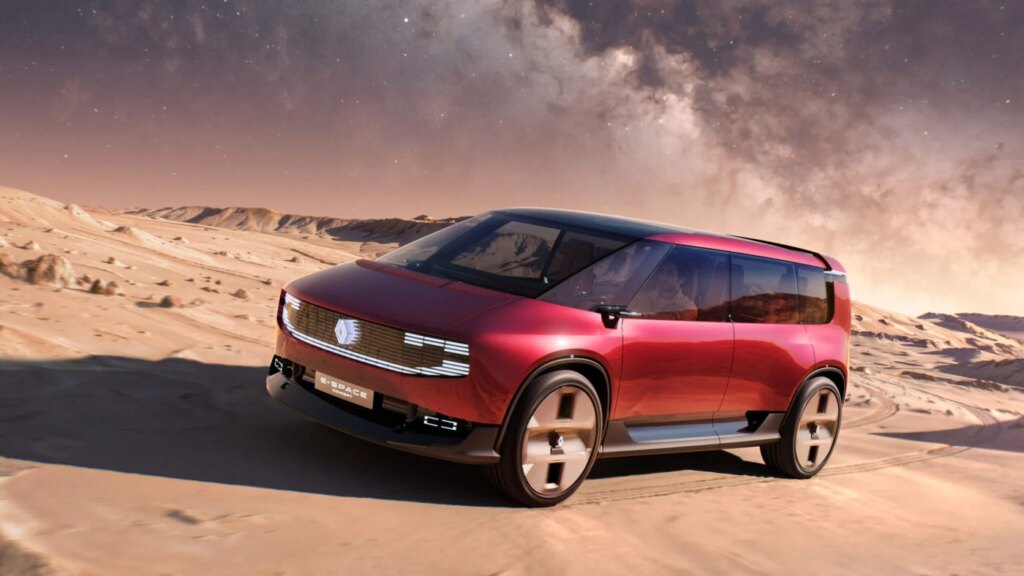
Renault revives the Espace concept from 1984. At the 2026 Paris Motor Show, the French manufacturer will present the E-Space Concept, an all-electric design study that is positioned as a modern successor to the Espace from 1984. This means that it retains the silhouette of a classic large minivan, a body that is also making a comeback with models such as the Volvo EM90, the Lexus LM or the Zeekr 009.
Measuring 4.70 meters long, 2.02 meters wide and 1.67 meters high, the E-Space combines familiar proportions with very short overhangs and 23-inch wheels. While Renault has not provided details about the drivetrain, the electric pickup truck is said to feature a retractable front splitter that reduces air resistance at high speeds to improve efficiency.
Renault developed the E-Space from the inside out
The development of the Renault E-Space began with the interior, as the manufacturer emphasizes that the concept is designed around human needs and is intended to serve as a “rolling living space.” The cabin is said to feel light and airy thanks to the large glass surfaces and low windows. The doors open in opposite directions, providing pillar-free access. The flat floor accommodates six individual seats. Those in the second row can be rotated 180 degrees to face the third row, or can remain facing forward to use the two 12.3-inch screens on the back of the front seats.
The second row seats can also be folded into a table. This allows passengers in the third row to sit at the table with a clear view of the two monitors, for which they also have video game controllers at hand. To add luxury on board, Renault has integrated a mini fridge and air purifier into a sliding console.
Cozy interior with widescreen
The driving position of the E-Space is equipped with a curved panoramic screen (1,130 x 110 mm) that occupies the entire width below the windshield. It serves only as a screen and does not have touch functionality. Operation is carried out through two flexible touch screens located next to the steering wheel. Renault calls the overall concept OpenR Panorama and it will be introduced in upcoming high-end Renault models, notably the Renault Rafale and Scenic. This study provides a preview of actual production plans, although it has not yet been confirmed whether the completed van will receive a production successor.
For the interior design, Renault uses striking colors and a style inspired by the 70s. This is also noticeable in the three-centimeter-thick wool carpet that covers the floor. For the tables and decorative surfaces, the manufacturer uses colored straw, while the steering wheel is covered with a biomaterial made from castor oil and cotton. The paint contains bio-based resins and the tires are made from approximately 19 percent sustainable natural rubber.
The brand has committed to using at least 30 percent recycled materials across its model range in the future. With the E-Space Concept, Renault goes a step further and uses the studio primarily as a technology carrier for renewable and bio-based alternatives, with the aim of relying not only on recycled materials but also on fully renewable raw materials in the future.
press.renault.de