
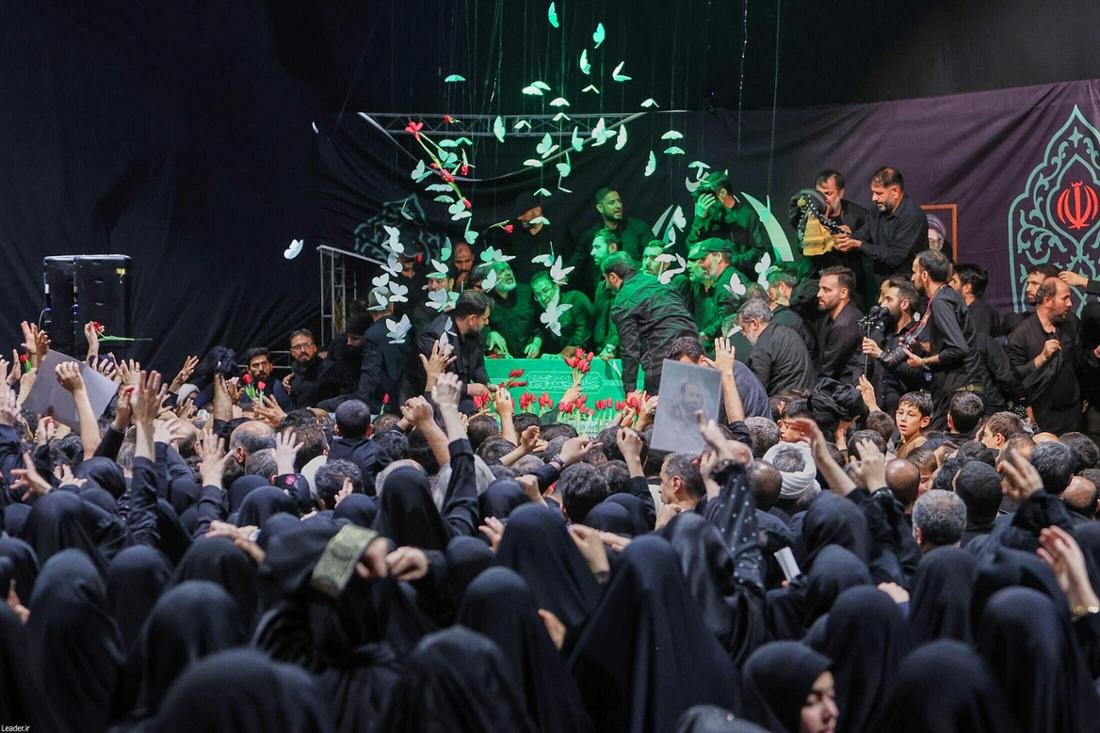
Iran expects millions of mourners – warning to enemies
Follow us on Google
Iran is in mourning: the slain Supreme Leader Ayatollah Ali Khamenei will be remembered over several days. The funeral ceremonies last several days.
Tehran – Iran’s Revolutionary Guards issued a sharp warning to the country’s enemies shortly before the start of funeral ceremonies for the slain Supreme Leader Ayatollah Ali Khamenei. “Any miscalculation will be met with a decisive and even harsher response than ever before. A response that will forever be recorded in its history of shame,” said a statement from the Revolutionary Guard carried by Iranian media. The embassy comes at a time when a fragile ceasefire is in place and Washington and Tehran are negotiating a permanent agreement to end the Iran war.
From this Saturday, the official funeral ceremonies will begin in Tehran for Khamenei, who was killed in an air strike on his official residence on February 28th – on the first day of the Iran war started by the USA and Israel. Iran’s Supreme Leader had been at the head of the clerical system for almost 37 years. Khamenei’s death marked the beginning of weeks of fighting in the Iran War. The impact of the conflict was felt worldwide through the blockades in the Strait of Hormuz. Representatives from the USA and Iran have now been able to agree on a ceasefire. This is considered fragile and further negotiations are scheduled to take place after Khamenei’s funeral service.
Funeral ceremony in Iran for Khamenei: Authorities expect millions of mourners
The funeral ceremonies for Khamenei, which were originally planned for the beginning of March, were initially postponed due to the Iran war. Now they extend over six days and take place in five cities: from Tehran to the Iranian cities of Qom and Mashhad to the Iraqi pilgrimage sites of Najaf and Karbala. Parliament Speaker Mohammed Bagher Ghalibaf, who also serves as chief negotiator in the talks with the USA, spoke of “one of the most defining moments in the country’s history”. He called on the Iranian people to “write a glorious chapter in the history of Islamic Iran” through their presence. In this way, Khamenei’s death should be avenged.
Khamenei’s body has already been laid out in the Mosalla Grand Mosque in Tehran, the Islamic Republic’s most important site for national ceremonies and mass events. Photos from the state news agency Fars also showed the head of the Revolutionary Guards, Ahmad Wahidi, paying his last respects to the slain leader.
The authorities expect 15 to 20 million participants in the three-day memorial service for Khamenei in Tehran alone. More than 65,000 security forces are deployed in the major cities, and another 200,000 are securing the affected provinces. The capital will be “completely closed and non-working” for the duration of the ceremonies, authorities ordered.
Funeral service for Khamenei: Increased security measures in Iran
Tightened security measures are in place in Iran due to the funeral ceremonies for Khamenei. The airspace over Tehran will be partially closed from Friday and completely closed on Monday. High-ranking state guests from around 30 countries traveled, including former Russian President Dmitry Medvedev, Pakistan’s Prime Minister Shehbaz Sharif and government representatives from China, Belarus, Iraq and Turkmenistan, as reported by the Iranian news agency, among others IRNA writes.
After the Tehran ceremonies, Khamenei’s body will be taken to the pilgrimage city of Qom and then to Iraq. By including the Iraqi cities of Najaf and Karbala in the program, the organizers want to underline the connections between the Islamic Republic and the international Shiite community. Ali Khamenei will finally be buried on July 9th in the holy city of Mashhad in northeastern Iran.

According to AFP, the funeral procession in Qom, south of Tehran, focuses on the religious foundations of Khamenei’s authority: with several theological universities, the city is, along with Iraq’s Najaf, an important center of Shiite scholarship. Karbala is one of the holiest sites in Shiite Islam. The funeral procession there is likely to focus on themes such as “willingness to sacrifice, perseverance and resistance”. The memorial service in Najaf is intended to underline Khamenei’s position within the Shiite world beyond the borders of Iran. By including Najaf in the program of funeral ceremonies, organizers in Tehran want to highlight the connections between the Islamic Republic and the entire international Shiite community.
After Khamenei’s death: son Majtaba is the new Supreme Leader
In the midst of the ongoing Iran war and the ongoing peace negotiations, a new leadership team has been established in the Islamic Republic. It is formally headed by Moschtaba Khamenei, the son of the slain Supreme Leader, who was appointed his successor. Like his father, he is considered to be extremely conservative and close to the Revolutionary Guards. He has kept a low profile since his appointment, although he has made numerous written statements.
The most prominent face of Iran’s new leadership is Ghalibaf, who led Iran’s negotiating teams in Pakistan and Switzerland. Israeli Iran expert Beni Sabti warned the AFP news agency against misjudging him: “No one should be deceived by his demeanor – he knows how to talk to the West.” But it is “the same man” who, as commander of the Revolutionary Guards, “he personally threw students off the roof during the protests at that time.” (Sources: dpa, AFP, Al Jazeera, IRNA) (fbu)