
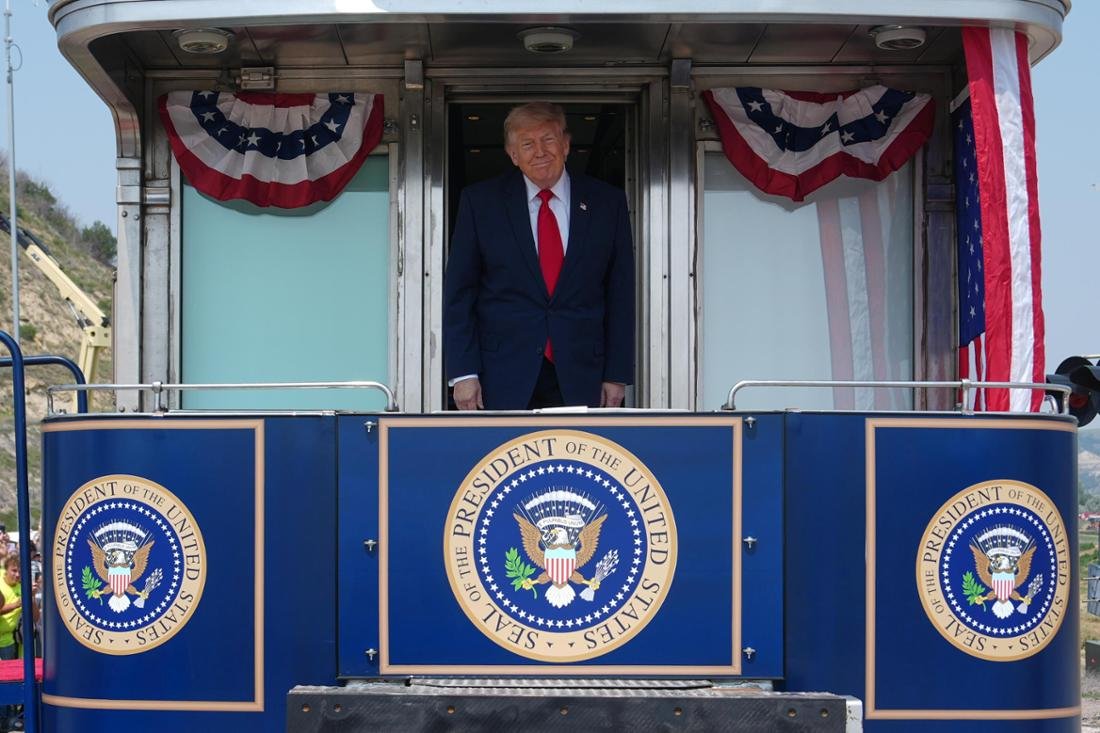
Trump celebrates 250 years of the USA: That is not patriotism
Follow us on Google
The USA is celebrating its 250th anniversary – especially Donald Trump. But there is a huge imbalance, says columnist James Warren Davis.
Strictly speaking, today is not the 250th anniversary of the American Republic. The United States as it exists today came into being with the ratification of the Constitution on June 21, 1788. It replaced the failed Articles of Confederation, but was itself an imperfect document, postponing a solution to the “peculiar institution” – the euphemism for slavery that remained deeply rooted in the Southern states. It was only a bloody four-year civil war that led to its abolition in 1865, even if we have never fully atoned for our original sin to this day.
Today, July 4th, we celebrate the 250th anniversary of the signing of the Declaration of Independence. With it, thirteen British colonies declared their desire to break ties with the mother country and unite as independent states. How exactly this would happen was still unclear at the time. Nevertheless, the declaration marked a turning point because it created a common identity based on a commitment to a set of ideals. In this sense, America is less a place or an institution than an idea.
Reagan said: “Any person (…) can come to America and become an American.”
While the Constitution is the result of political negotiation and compromise, the Declaration of Independence is a document of overwhelming size and universal appeal. “We hold these truths to be self-evident: that all men are created equal; that they are endowed by their Creator with certain unalienable rights; that among these rights are life, liberty, and the pursuit of happiness.”
Self-evident truths are not bound to time or place. This is the appeal of the Declaration of Independence – and one reason why people in the United States and around the world continue to draw inspiration and courage from it to pursue their dreams.
For two hundred and fifty years, the American dream attracted wave after wave of immigrants. Because belonging to the American community never depended on common descent or religion. To be American is to embrace a civic creed. Ronald Reagan put it well: “You can move to France, but you cannot become French…Any person, from any corner of the world, can come to America and become an American.”
As Reagan demonstrated again and again, Americans are a proud people who take patriotism for granted. Yes, we sometimes appear loud and self-confident. But what’s wrong with loudly proclaiming the equality of all people and the value of freedom?
250 years of the USA, just under Trump: “a form of political idolatry”
Unfortunately, some of the loudest voices today belong to those who surround themselves with the symbols of America – while proclaiming the primacy of certain religions and claiming that people whose families have lived in the country for generations are more “real” Americans than those who have recently immigrated.
Hardly anyone can analyze the USA, its politics and Donald Trump better than him: the American political scientist James W. Davis. He is a proven expert in US politics and international relations and has been teaching in German-speaking countries for decades.
However, anyone who drapes themselves in the flag but sacrifices the ideals of the Declaration of Independence for a policy that secures power and privileges and denies others the chance for happiness is confusing the symbol with the essence. Using America’s symbols while betraying its ideals is not patriotism. It is a form of political idolatry.
The signers’ commitment to the Declaration of Independence was not to a tribe, a bloodline, or to the nation as it then existed. No – they committed themselves to one principle: the self-evident truths that they had just proclaimed. And they did so at great personal risk but with confidence, solemnly pledging to one another “our lives, our fortunes, and our sacred honor.” (James Warren Davis)