
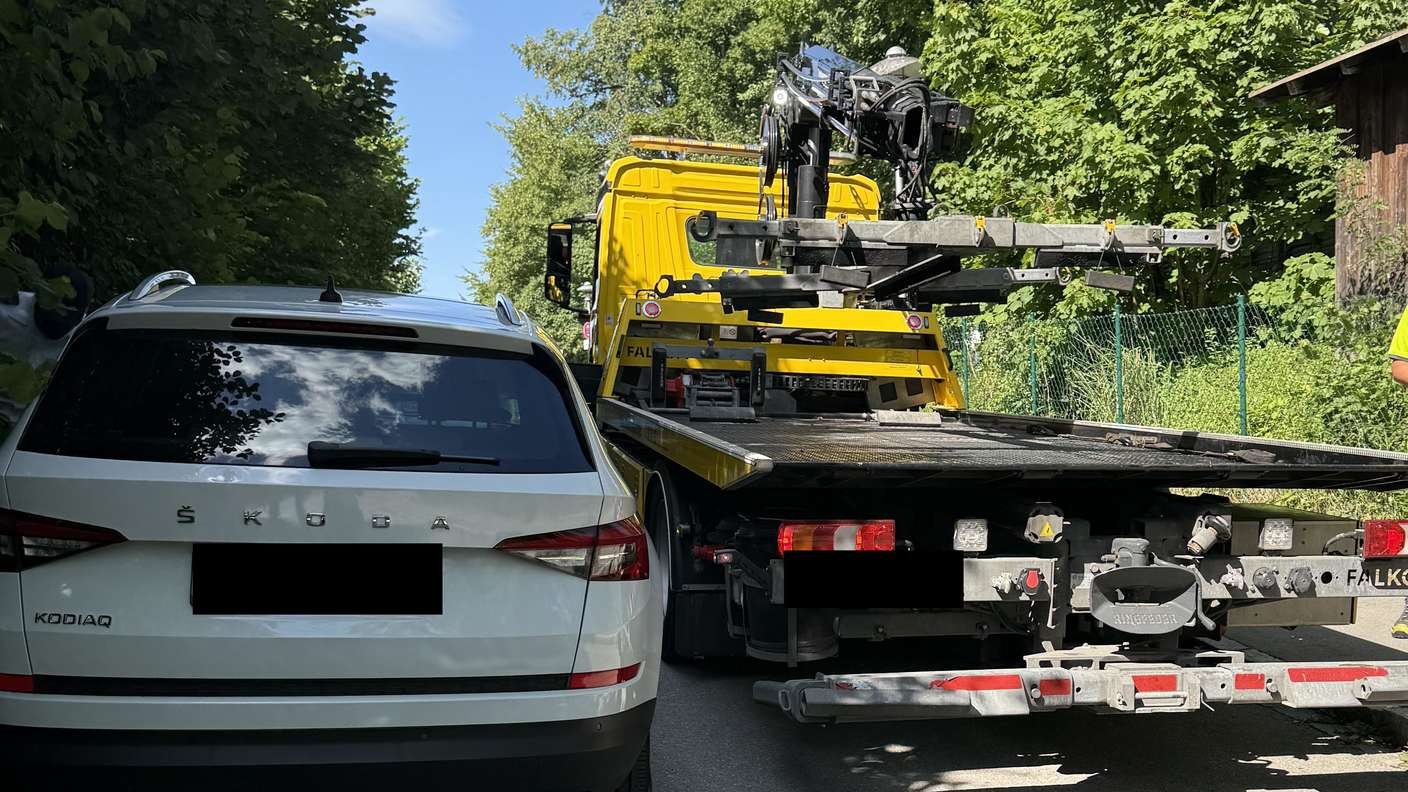
Those who park illegally must expect to be towed on Lake Starnberg
Follow us on Google
The simplified towing procedure was used for the first time in Starnberg last weekend. The traffic monitors reported this on Thursday. It caught someone parking illegally on Unteren Seeweg.
Starnberg – The traffic monitors from the Oberland Municipal Services Association from Bad Tölz used the simplified towing procedure for the first time in Starnberg last weekend. Under certain conditions, you can have illegal parkers towed away independently without having to wait for a police patrol to assess the situation on the spot. However, the police still need to be involved and informed.
Everyone involved pursues the same goal: more security for citizens and the best possible conditions for emergency services.
“This shortens decision-making processes and eliminates danger areas much more quickly,” the association announced on Thursday. The conventional procedure is often time-consuming and reaches its limits when police forces are still needed for traffic accidents or other urgent operations. “The dangerous situation on site often continued.” Now escape routes and other safety-relevant areas could be reopened much more quickly.
Parking illegally blocks escape route
Specifically, it was about a driver who had parked his Škoda on the Unterer Seeweg. “The vehicle was parked in such a way that the escape route was blocked,” explained Simone Bräu from the association when asked by Starnberger Merkur. Traffic monitors discovered the violation last Saturday around 2:45 p.m. and called a towing company.
Although the vehicle owner showed up just in time before his car was hoisted onto the truck and transported away, the operation was still likely to be expensive for him. Simone Bräu: “The vehicle owner will be charged a fine of 55 euros. In addition, there will be towing costs of around 400 euros.” The same is likely to apply to another case that occurred on Saturday. This was also “a serious parking violation.” And in this case, too, the owner showed up before the car was towed, the spokeswoman reported.
The city of Starnberg had already reached an agreement with the special purpose association and the Upper Bavaria North police headquarters in August last year to introduce the simplified towing procedure and also identified local danger points and safety corridors. In Starnberg these are the Untere Seeweg in the area of the bicycle road and the Steininger property as well as the Buzentaurweg in Percha with the access to the parking lot and the water rescue station.
However, the procedure was no longer used last year. On a planned day of action on August 16th, the weather was so bad that there was hardly any traffic at the critical points on the lake. At the meeting of the city council’s main and finance committee this May, the city administration emphatically pointed out that it wanted to use the procedure to “enforce the keeping of escape routes clear in practice more consistently”. The traffic monitors are allowed to implement the regulation “at any time,” Starnberg’s managing director Ludwig Beck said at the meeting.
Increased controls from July 24th to 26th
“The agreement shows how well the cooperation between the communities, the responsible police stations and the special purpose association works,” emphasized Maximilian Brummer, Head of Stationary Traffic at the special purpose association. “Everyone involved pursues the same goal: more security for citizens and the best possible conditions for emergency services.” It’s not about towing as many vehicles as possible, emphasized Brummer. The current case makes it clear that towing measures do not only exist on paper.
The association has already announced a campaign with increased controls around Lake Starnberg for the weekend from July 24th to 26th. Agreements on agreed towing also exist in the municipalities of Berg, Münsing and Tutzing.
Vice Mayor Angelika Kammerl is fully behind the concept. “It’s about ensuring that emergency vehicles get through quickly and safely,” she told Merkur. Unfortunately, road users repeatedly ignore the relevant signs. “We can’t avoid doing this all summer long.”