
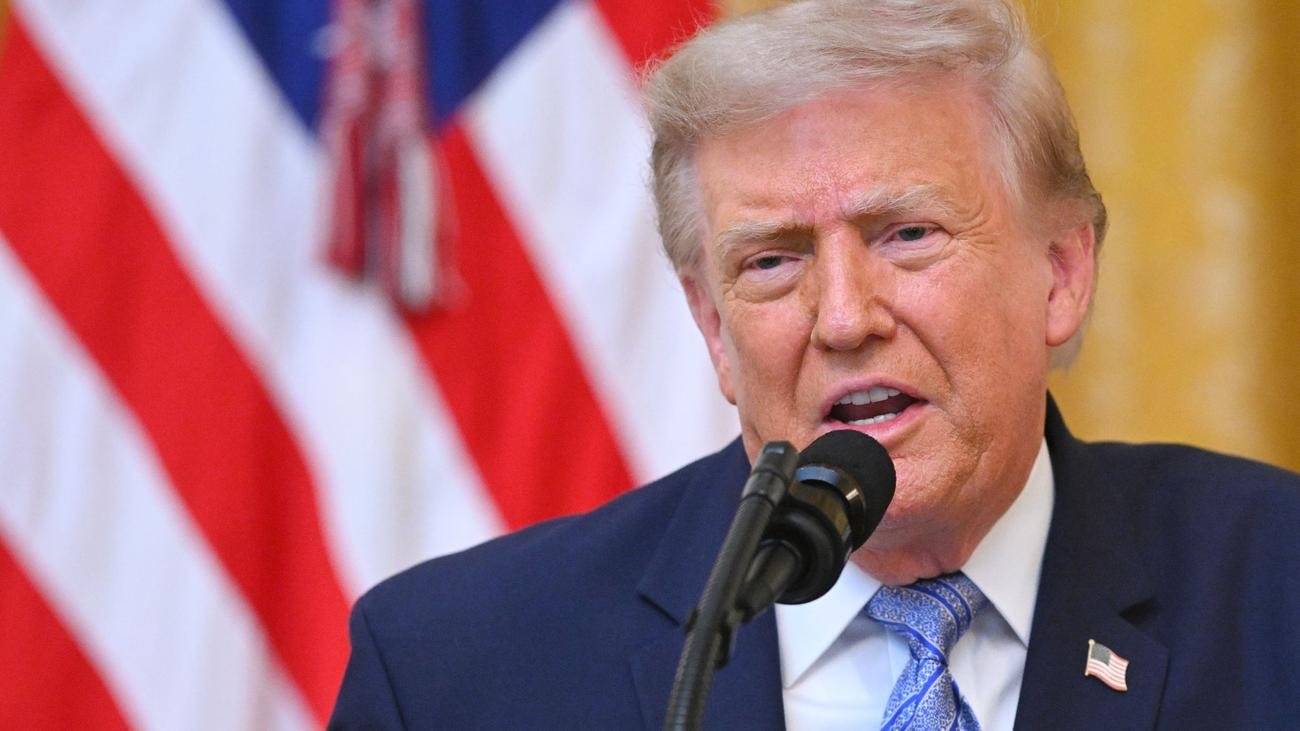
Accusation against China: Trump is raising doubts about the security of elections before the “midterms”.
Before the midterm elections in the USA, President Donald Trump expressed doubts about the integrity of elections in his own country – for example with allegations of attempted Chinese influence from 2020. In a speech to the nation, Trump repeated his false claim that there was fraud in the presidential election that year, but went further than this accusation. Should last for years China tried to prevent Trump’s electoral success.
The US President announced that he would release intelligence data on this and other “shocking vulnerabilities in our election infrastructure” that had previously been kept under wraps.
No evidence yet to support similar claims
Even years after Democrat Joe Biden’s victory in the 2020 presidential election, Trump’s anger over his defeat runs deep – he still does not recognize it to this day. Trump also repeatedly suggests alleged major fraud through postal votes and voting machines. He has not yet provided any evidence for this.
“Tonight, Trump made a pathetic attempt to deny what has long been clear to all of us – that he lost the 2020 election,” said Democratic Senate Minority Leader Chuck Schumer. “To be clear: In America, voters choose their politicians, not the other way around.”
Democrats had also feared before Trump’s speech that he could try to undermine trust in fair and free elections with a view to the midterm elections in November.
Trump only mentions the Iran war in one sentence
Every American has the right to know that their vote will be counted correctly in an election, Trump said in his prime-time address. You need a system in which fraud and interference are practically impossible. “Unfortunately, the system we have today falls catastrophically short of this standard.”
Trump rarely uses such speeches. While many US citizens are concerned about high gas prices and dissatisfaction over the Iran war, Trump spoke almost exclusively about elections. He only mentioned the war in Iran, which has escalated again in the past few days, in one sentence.
Instead, he accused Beijing in detail of having carried out “probably the largest theft of election data in history” starting in 2020. The result was 220 million stolen voter data, including names, phone numbers and party preferences.
Trump is fueling mistrust about the security of voting machines
However, the allegations against China were far from the only ones that Trump made in his portrayal of an allegedly unsafe electoral system in the USA. For example, he claimed that Americans had been lied to for years about the security of voting machines and digital counting systems – an accusation that he has not made for the first time. According to Trump, his Department of Homeland Security has also identified more than 270,000 people who are registered to vote in federal elections but are not US citizens.
In the USA, the organization of these elections lies primarily with the states. As a rule, voters have to register here before the election and prove their citizenship. In many states this happens automatically, for example when applying for a driver’s license. According to the Bipartisan Policy Center think tank, there is no evidence that non-citizen voting has ever been significant enough to affect the outcome of an election.
Democrat expressed doubts about the evidence
Trump based his allegations, among other things, on raw material from secret services or statements from individual officials. That’s exactly what Jim Himes, the highest-ranking Democrat on a House intelligence committee, warned about Trump’s speech.
“Sources are sometimes unreliable” – and raw data collected by secret services is full of falsehoods, he wrote in a guest article in the New York Times. “A robust intelligence analysis combines hundreds of different sources of information with expertise to create something we can verify and trust.” Himes feared that Trump could use such claims to undermine the American people’s trust in their own elections.
In the so-called midterms in November, US citizens will, among other things, re-elect the entire US House of Representatives and part of the Senate. There is a lot at stake for Trump’s Republicans: If they lose their slim majority in even one of the chambers, they will no longer be able to pass any major legislative initiatives.
Attempts to exert influence are known – also in favor of Trump
The fact that foreign forces are trying to influence US elections is nothing new. The Russian government made an “aggressive, multi-pronged attempt” to influence US voters in favor of Trump in the 2016 presidential election, according to a report by the Senate Intelligence Committee. The Brennan Center think tank describes such attempts from abroad as a permanent threat. Russia, China and Iran in particular are involved.
Trump’s serious allegations come just two months after his state visit to Beijing. There he praised President Xi Jinping and described him as a “friend”. It is not known that Trump addressed the issue of election fraud. In his address to the nation, Trump did not mention Xi by name.
Trump lobbies for new election law
With his warnings, the US President set himself a great example in order to promote his election law, which has been stuck in Congress for months. The so-called Save America Act provides, among other things, new hurdles for voting, such as proof of identity or postal voting. If Congress passes the law and another regulation, Republicans would never lose another election, Trump had previously said.
Elections are currently bad in many states, Trump claimed in his speech. “We are committed to fixing this,” said the US President. He left it open what the concrete consequences of this would be.
© dpa-infocom, dpa:260717-930-397318/2