
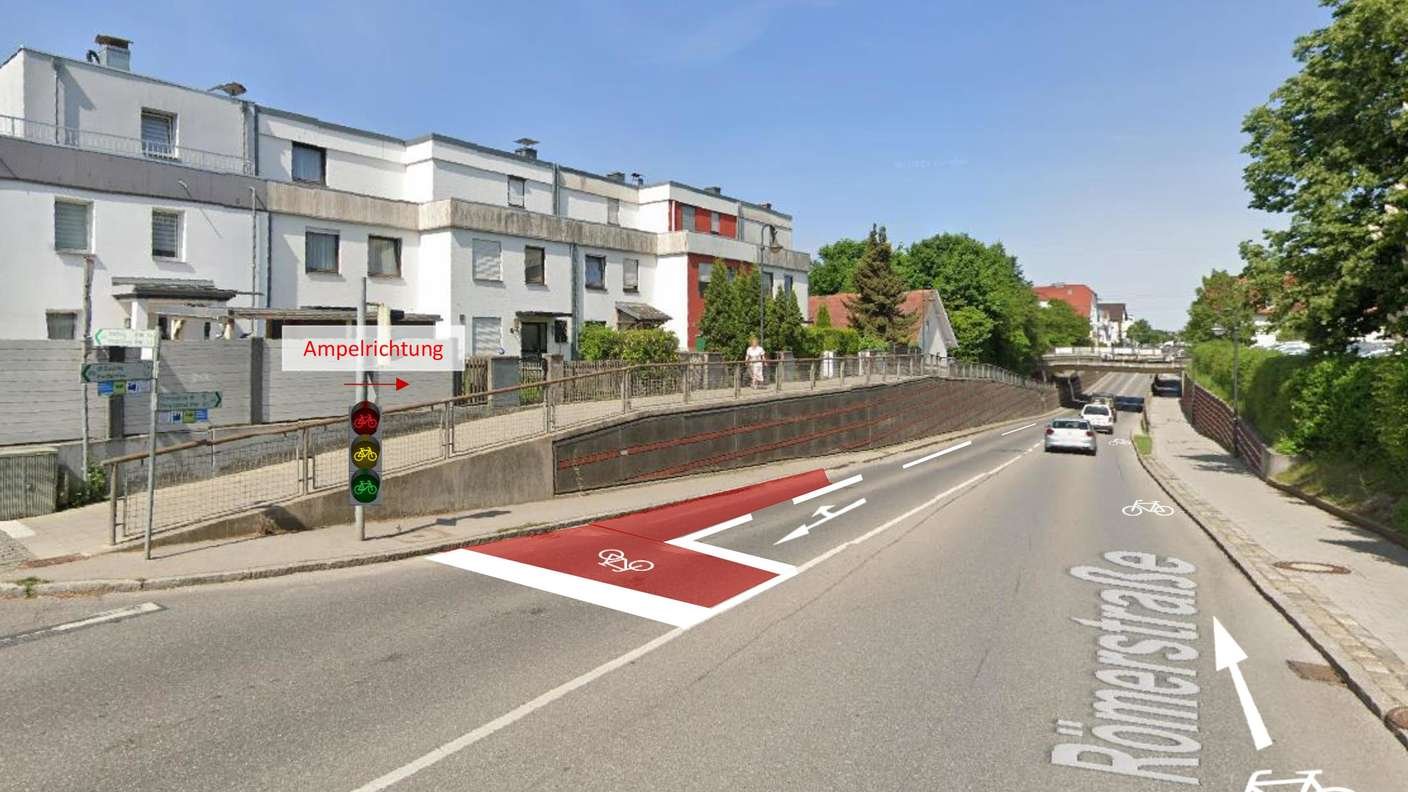
Cyclists will have to drive through the underpass in the future
Follow us on Google
The Gilching local council decided by a vote of 6:5 to reorganize cycling on Römerstrasse. The existing sidewalks and cycle paths on the ramps will in future only be reserved for pedestrians.
Gilching – The meeting of the Environment, Energy and Transport Committee of the Gilching local council on Monday evening only had one item on the agenda. But he had it all. It was about the “reorganization of bicycle traffic on Römerstraße in the section Am Bahnhof to Münchener Straße”. The most important results: Cyclists should pass the underpass under the railway line on the road in the future, there should be cycle protection lanes and other markings, and the maximum speed should be reduced from 50 to 30 km/h at the same time.
The initial situation
So far, there is a shared footpath and cycle path on both sides of the underpass area on the ramps beyond the road. This repeatedly leads to conflicts between cyclists and pedestrians due to the narrow width, the speeds traveled and the sometimes confusing nature. In addition, there are confusing and even illegal signs as the process progresses. The Bavarian Ministry of the Interior warned about the latter at the corner of Römerstrasse and Landsberger Strasse, explained Mayor Stefan Siegl.
“The cyclist would have to get off to cross the intersection. In addition, the continuation of the footpath and cycle path is not clear,” said the draft resolution. In addition, the railing on the lower roadway does not meet safety requirements. It is only between 80 centimeters and 1.25 meters high, 1.30 meters is prescribed. The area is particularly dangerous for pedestrians, said Siegl. In addition, there would be “significant danger and conflict potential for non-motorized traffic” due to the traffic lights. Things don’t get any better further up to the confluence with Münchener Straße.
The proposed solution
In order to sustainably improve the situation and increase safety for all road users, the administration proposed a whole package of measures. This was developed with cycling experts during a workshop organized by the Association of Bicycle-Friendly Municipalities (AGFK).
- The shared footpath and cycle path on the ramps will be removed and will remain reserved for pedestrians in the future. Cyclists will have to use the road in the future.
- In the area of the underpass, 1.50 meter wide red bicycle protection strips will be marked on both sides – but only on the respective slopes. Bicycle pictograms will be marked on the downhill sections.
- At the junction with Landsberger Straße, a separate parking area is marked on the traffic lights for cyclists coming from the center, also in red. In addition, cyclists receive an earlier green phase than the rest of the traffic.
- As the Römerstraße continues to the confluence with Münchener Straße, pictograms will be marked on both sides of the road.
- The previous left-turn lane on Römerstraße in the direction of the town center to the street Am Bahnhof will be eliminated in order to create more space for cyclists.
- On Römerstraße, the speed limit will be reduced from the current 50 km/h to 30 km/h between the junctions of Am Bahnhof and Münchener Straße.
The discussion
While Stefan Siegl saw the proposal as a “first approach” to make an existing problem area safer for all road users, the opinion in the committee was divided. “I am afraid of this proposal,” said Oliver Fiegert (BfG). He’s just imagining himself standing on the parking area with his bike and a truck or a bus waiting behind him. Of course, the current signage for cyclists in the area is “pretty confusing,” he said. Because of this, Fiegert considered “forcing” cyclists into the underpass to be the wrong route. The planned markings also meant that drivers would always end up in oncoming traffic when overtaking cyclists “wobbling uphill at 10 km/h”.
Roland Schrafstetter (CSU) even considered it “life-threatening” to ride a bicycle on the street in the underpass. When the underpass was built in 1987, the cycle path was deliberately created on the ramps. Gradients of six to eight percent are too steep for many cyclists, he said. Group colleague Thomas Beiwinkler spoke of a “gorge character” that would probably deter many cyclists from cycling there.
Lisa Bock (Greens), however, expressed “praise and approval”. There is no ideal solution at this point, but the proposal is a start to improving the situation, she emphasized. It was also important that “professionals” from the AGFK were involved in the development. Sophie Hüttemann (SPD) also spoke of an “important step”. Eduard Segerer (FW) saw the proposal as “an improvement for pedestrians and cyclists”, as did his group colleague Pia Vilsmayer. She did not accept criticism of the lack of overtaking opportunities. “If drivers have to drive 30, they don’t have to overtake anyone,” she said
The decisions
In the end, the committee made three resolutions – very narrowly with 6:5 votes each, with the majority coming from the FW, SPD plus, Greens and Mayor Siegl against the CSU, AfD and BfG. A request from Roland Schrafstetter to postpone and call an on-site meeting was rejected by a vote of 6:5. “We all know the situation. What’s the point of an on-site visit?” Pia Vilsmayer said. A proposal from Oliver Fiegert to turn the existing footpaths and cycle paths into pure sidewalks, but with the addition “cyclists free”, was also rejected by a vote of 6:5.
The administration’s proposal was approved with a vote of 6:5. It is now tasked with implementing this and carrying out the necessary traffic law and technical coordination with the responsible authorities.